
The Hotel That Could Not Be Drilled
The hotel is a 14-room boutique property on the island of Mykonos. White stone walls. Blue domes. Narrow alleyways that have not changed in a century. The current owner — a Greek family based in Athens — intends to keep it standing for another hundred years.
The problem was security. The hotel sits empty for six months of the year. November through April, when the tourists leave and the island quiets down, the property is vulnerable. Break-ins at seasonal hotels are common across the Greek islands. Empty rooms mean easy targets.
The owner needed a security system. There was one condition: no one was allowed to drill through the stone walls.
The walls of the Mykonos property are 60 centimeters thick. Solid stone. Not drywall. Not brick with cavity. Drilling would mean permanent damage to the historic structure. The owner, whose family has owned the building for three generations, refused to allow it.

Why Standard Security Systems Would Not Work
The installer who took the call had experience with historic buildings. He understood the limitations immediately.
Drilling for cable runs was out of the question. Stone walls this thick cannot be patched to look original. Even a single drill hole is permanent damage that reduces the building’s heritage value.
Wireless systems using Wi-Fi or Z-Wave could not penetrate 60cm of stone. Most consumer wireless security products are designed for timber frames and drywall. Through solid stone, signal strength drops significantly through solid stone — often to unusable levels after a single partition. In a 14-room building with multiple stone partitions, coverage would stop at the first room.
Surface-mounted cables would ruin the aesthetic. The visual character of Mykonos architecture is part of the hotel’s appeal. Exposed conduit or cable trays would not pass the owner’s standards — and would likely violate local preservation guidelines.
The owner had called two other installers before this one. Both said the same thing: a proper security system required running cables somewhere. The installer almost walked away too.
The Roombanker Solution: 868 MHz Through 60cm of Stone
The installer had read about the RBF Protocol’s penetration characteristics — 3,500 meters (2.17 miles) in open air, with stable performance through dense construction materials. He decided to test it before committing.
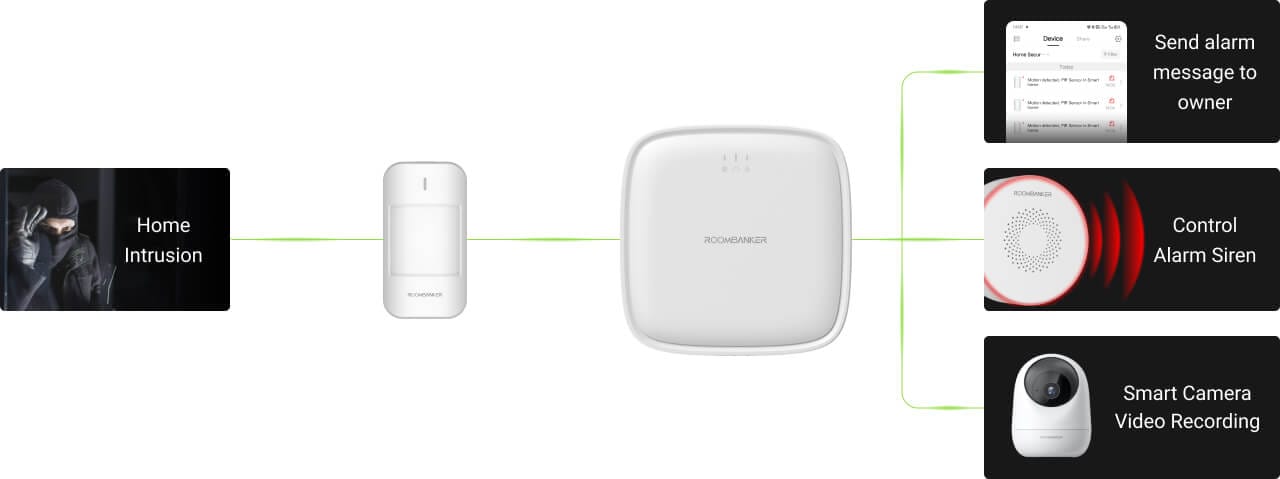
He mounted the Roombanker Hub in the manager’s office — a small room near the hotel entrance on the ground floor. The Hub is compact enough to sit on a shelf next to the property management computer. No visible antennas. No blinking lights that would distract guests. The clean industrial design was a deliberate choice for hospitality environments.
Then he walked through the hotel with the signal testing mode on the RB Link app. Room to room. Floor to floor. Through the 60cm stone walls that should have killed any wireless signal at the first partition.
The RBF Protocol passed through every wall he tested. Signal strength remained in the green across all 14 rooms and three floors. The lower frequency of 868 MHz — compared to 2.4 GHz used by Wi-Fi and Z-Wave — gives it fundamentally better building penetration. This is physics, not marketing.
The installer placed PIR motion sensors in the common areas and corridors. Door and window magnetic sensors on all ground-floor entry points. An Outdoor Alarm Siren on the rear wall, fully wireless and visible from the street as a deterrent.
Total pairing time for 18 devices: 20 minutes. Total installation time: one afternoon.
The Result: Protected for Six Months of Silence
The full installation was completed in five hours. Hotel staff were trained on the RB Link app in under an hour.

| Metric | Result |
|---|---|
| Installation time | 5 hours |
| Structural damage | Zero — no holes drilled through stone |
| Devices deployed | 18 (sensors, sirens, controls) |
| Coverage | 14 rooms, 3 floors, all common areas |
| Signal penetration | 60cm stone walls cleared without repeaters |
The owner, based in Athens during the winter months, monitors the property through the RB Link app. If a sensor is triggered, he receives a push notification within seconds. He can check the status of every device from his phone, wherever he is.
The system is configured in vacation mode during the off-season: perimeter sensors armed, interior motion sensors disabled to avoid false alarms from building settling or small animals. In six months of operation through the 2025-2026 winter, there were zero false alarms.
“The hotel sits empty for half the year,” the owner said. “I needed to know that if something happened, I would know about it immediately. But I was not willing to damage the building to get that peace of mind. Roombanker gave me both.”
What the Installer Says
“Historic buildings are a nightmare for security installation. Every time I get a call for a pre-1920s building, I expect to walk away or compromise. The Mykonos hotel was different.
“The RBF signal went through those stone walls the way the spec sheet said it would. I did not have to apologize for drilling holes in a historic building or tell the owner that wireless does not work through stone. It just worked. I left the site with a customer who was genuinely happy, not one who felt they had to accept a compromise.”
Frequently Asked Questions
Can the RBF Protocol penetrate stone walls?
Yes. In internal testing at our 35,000m² manufacturing facility, the 868 MHz signal maintained stable transmission through reinforced concrete walls up to 40cm thick. Field results at the Mykonos hotel demonstrated reliable coverage through 60cm solid stone construction. Actual performance depends on stone density and moisture content, but the RBF Protocol’s lower frequency gives it a fundamental advantage over 2.4 GHz alternatives.
What is vacation mode and how does it work?
Vacation mode keeps perimeter sensors — doors, windows, and ground-floor entry points — actively armed while disabling interior motion sensors. This prevents false alarms from building settling, temperature changes, or small animals while maintaining security at all entry points. The mode is configured through the RB Link app and can be scheduled or activated manually.
How do I monitor an empty hotel remotely?
The RB Link app provides full system status from anywhere with an internet connection. You receive push notifications for alarm events, tamper alerts, and system faults. The Roombanker Portal adds multi-site management for property managers with multiple buildings.
Will the system work without an internet connection?
Local alarm functions — sirens, entry delay, exit delay — continue operating if the internet goes down. The Hub buffers all event data and syncs automatically when the connection restores. Remote monitoring requires internet access.
How many devices can one Hub support in a hotel or hospitality setting?
A single Roombanker Hub supports up to 128 wireless devices. For a boutique hotel of 14 rooms, one Hub provides complete coverage. Larger hotels can add additional Hubs for segmented management of different wings or floors.
Do the sensors blend with historic or traditional architecture?
Roombanker sensors have a low-profile industrial design with white finish. The PIR Motion Sensor is roughly half the size of a smartphone and mounts flush to the wall. The Door/Window Magnetic Sensor is barely visible against a white door frame. For heritage buildings where even these are noticeable, the sensors can be placed in less visible locations such as ceiling corners or behind furniture while maintaining coverage.
Get the Hospitality Security Guide
Download our free guide to securing seasonal hotels, vacation rentals, and hospitality properties. Covers: system design for historic buildings, vacation mode configuration, remote monitoring best practices, and sensor placement for aesthetic sensitivity.
Download the Free Hospitality Security Guide
Interested in becoming a Roombanker partner for hospitality projects? Contact your regional distributor for training, pricing, and technical support.