
How Multi-Year Battery Life Changes the Security Installation Business Model
Published: May 24, 2026 | Reading time: 9 minutes | Category: Industry & Trends
A security installation company in Madrid had 2,400 service callouts last year. Roughly 720 of them — 30 percent — were for dead sensor batteries. Each call cost them an average of EUR 65 in van time, labour, and the battery itself. That is EUR 46,800 a year spent on the most preventable problem in the industry.
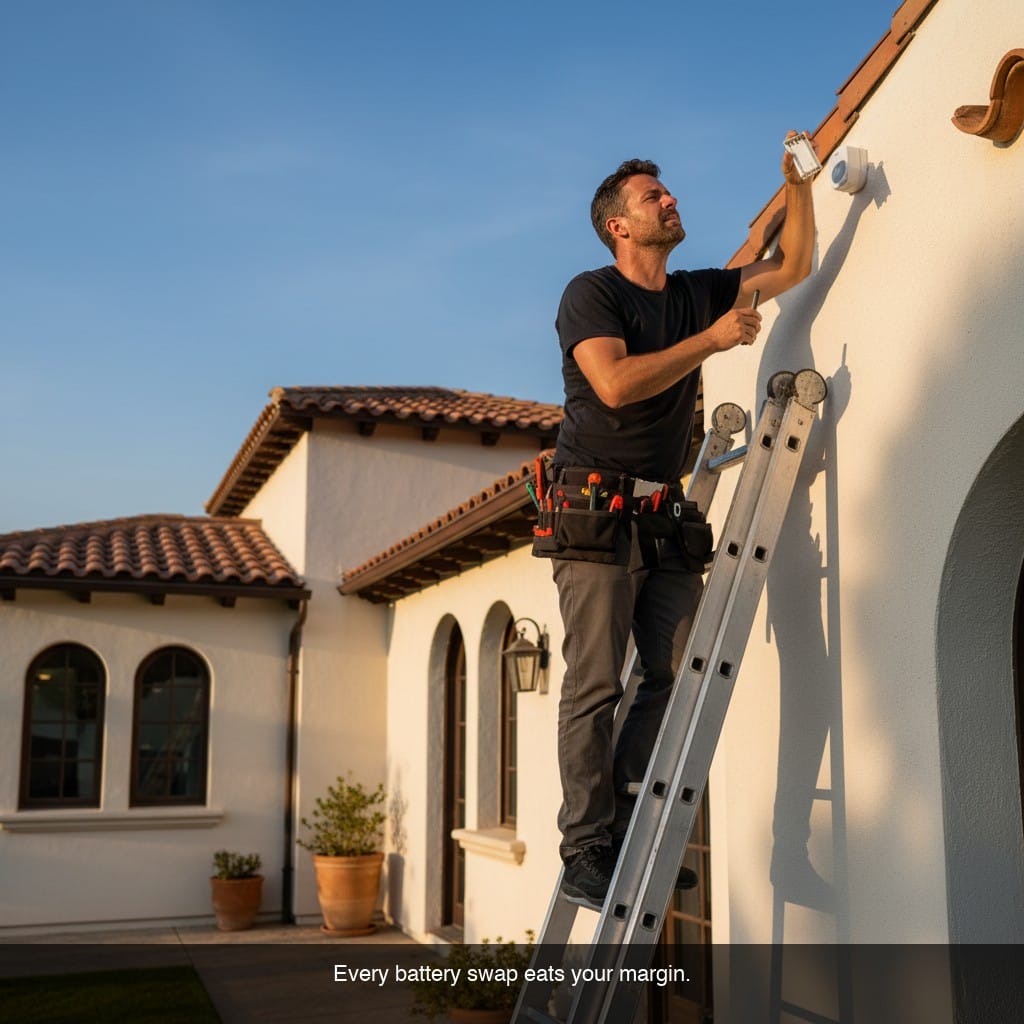
This is not a small expense for an installer. In markets where monthly monitoring fees have been compressed to EUR 15-25 per customer, one maintenance callback can wipe out two years of profit from that account. The math forces a choice: either subsidise the callbacks out of margins or bill the customer and risk losing them to a competitor.
But what if the sensors lasted 5-7 years without a battery change? What if that 30 percent of callbacks simply disappeared?

The Maintenance Cost Problem in Numbers
To understand the opportunity, start with the cost structure. Industry data from European security providers shows the following:
| Item | Cost (EUR) | Frequency |
|---|---|---|
| Annual maintenance contract (typical commercial system) | EUR 115-150 | Yearly |
| Battery replacement (per sensor) | EUR 4-5 (alkaline) | Every 1-2 years |
| Emergency callback (labour + travel) | EUR 50-80 | As needed |
| Battery replacement at siren | EUR 52 | Every 2-4 years |
Source: Published maintenance pricing from Bevex Alarm (Belgium) and Security Systems (Netherlands); battery costs from industry retail data.
Note that in standard maintenance contracts, battery replacement is not included in the annual fee. It is billed separately. That means every low-battery notification generates a separate chargeable event — and every callback risks damaging the customer relationship.
Where the Revenue Leak Happens
Consider a typical installation: a 3-bedroom house with 8 door/window sensors and 4 PIR motion detectors. With standard alkaline batteries:
- Door/window sensors: 5,000-10,000 transmissions per year. Alkaline batteries last 12-18 months.
- PIR motion detectors: 500-2,000 activations per year depending on traffic. Alkaline batteries last 12-24 months.
- Smoke detectors and panic buttons: Lower frequency but critical reliability requirements.
For an installer managing 500 such sites, the annual battery replacement cycle looks like this:
| Sensor Type | Count per Site | Sites | Battery Life (alkaline) | Annual Replacements | Cost per Replacement | Total Annual Cost |
|---|---|---|---|---|---|---|
| Door/window sensor | 8 | 500 | 1.5 years | 2,667 | EUR 65 | EUR 173,355 |
| PIR motion detector | 4 | 500 | 1.5 years | 1,333 | EUR 65 | EUR 86,645 |
| Total | 12 | 500 | 4,000 | EUR 260,000 |
Assumes average callout cost of EUR 65 including labour, travel, and parts.
At EUR 260,000 annually, battery-related maintenance is not an operational cost — it is a significant drag on profitability that directly competes with new customer acquisition investment.
What Roombanker Sensors Change
Roombanker sensors achieve fundamentally different battery life figures because of how the RBF SIP Chip manages power consumption. The chip was designed from the ground up for low-power, long-range IoT communication — it is not repurposed silicon from a different application.
| Sensor Type | Battery Type | Typical Life (alkaline competitors) | Roombanker Life | Difference |
|---|---|---|---|---|
| PIR Motion Sensor (indoor) | Lithium | 1-2 years | 3-5 years | 2-3x longer |
| PIR Motion Sensor (outdoor) | Lithium | 1-2 years | 3-5 years | 2-3x longer |
| Door/Window Magnetic Sensor | Lithium | 1-2 years | 5-7 years | 3-5x longer |
| Keyfob / Panic Button | CR2032 | 1-2 years | 3-5 years | 2-3x longer |
Source: Roombanker internal lab testing conducted across 50+ residential and commercial sites in Poland and Germany, 2024-2025. Results based on typical usage patterns (PIR: 500-2,000 activations/year; door sensor: 5,000-10,000 transmissions/year). Actual battery life varies with signal strength, temperature, and transmission frequency.
The mechanism behind these numbers is the RBF Protocol’s transmission efficiency. Each packet transmission consumes roughly one-third the energy of comparable wireless protocols because the RBF SIP Chip integrates the RF transceiver, baseband processor, and power management into a single package with no excess circuitry. The sensor spends 99.8 percent of its time in sleep mode, drawing negligible current, and wakes only when triggered.

Why Lithium Matters More Than You Think
The shift from alkaline to lithium batteries in security sensors is often treated as a minor specification upgrade. In practice, it has three structural effects on the installer’s business:
1. Cold-weather reliability
Alkaline batteries lose significant capacity below 0°C. Outdoor sensors in European winters — particularly in Nordic and Central European countries — see voltage drop that triggers false low-battery alerts or causes transmission failures. Lithium maintains stable voltage down to -20°C. For an installer with outdoor PIR sensors on a Polish warehouse, this can eliminate an entire category of winter callbacks.
2. Voltage stability over time
Alkaline batteries exhibit a gradual voltage decline from 1.5V to 0.9V over their lifespan. Sensors must boost power to compensate, which reduces battery life further. Lithium maintains near-constant voltage until the final 5-10 percent of its capacity, giving predictable performance and more accurate low-battery warnings.
3. Fewer truck rolls per customer lifetime
Over a 7-year customer relationship, an installer with alkaline-powered sensors can expect 4-6 battery-related service calls per customer. With Roombanker’s lithium-powered PIR sensors and door contacts, that drops to 1-2 calls. The difference is material to the account profitability calculation.
Installer ROI: The Business Model Shift
Here is where the battery life story becomes a business model story. When an installer switches from standard wireless sensors to Roombanker’s long-life sensors, the economics of each account change fundamentally:

| Metric | Standard Sensors (alkaline) | Roombanker (lithium / RBF SIP) |
|---|---|---|
| Battery-related callbacks / year / 100 accounts | ~60 | ~12 |
| Annual callback cost / 100 accounts | EUR 3,900 | EUR 780 |
| Labour hours saved / year / 100 accounts | — | ~120 hours |
| Net margin improvement per account / year | — | EUR 31.20 |
Calculations based on EUR 65 per callback cost and 20 minutes average labour per battery replacement.
For an installer with 1,000 monitored accounts, the annual saving is over EUR 31,000. That is equivalent to adding roughly 200 new EUR 150/year monitoring contracts — without acquiring a single new customer.

One Turkish installer who switched to Roombanker for his factory installations described the effect this way: “Before, I was scheduling two full days a month just for battery callbacks. Now I schedule one afternoon every quarter. That is roughly 22 days a year I get back for new installations.”
How the RBF SIP Chip Enables This
The 5-7 year battery life of Roombanker door/window sensors is not achieved through larger batteries. The outdoor PIR sensor uses a standard lithium battery pack. The difference is in the chip.
The RBF SIP Chip integrates three functions that would normally require separate components:
- RF transceiver: Transmits at lower power than standard wireless modules because the RBF Protocol requires fewer retransmissions (the signal travels 3500 meters in open air, meaning it reaches the hub reliably through walls without power-hungry boosting).
- Baseband processor: Handles encryption, packet assembly, and protocol management in a single low-power core.
- Power management unit: Dynamically adjusts transmission power based on signal quality rather than always transmitting at maximum.
By integrating these functions into one package, the chip eliminates the energy waste that occurs when separate components communicate across circuit board traces. Each individual saving is small — microamps. But over 5-7 years of continuous operation, those microamps add up to years of additional battery life.
The Model Shift: From Break-Fix to Recurring Revenue
The most important change multi-year battery life enables is structural. Security installation businesses have historically operated on a hybrid model: upfront installation revenue plus modest recurring monitoring fees, with maintenance eating into the margin. When maintenance costs drop toward zero, the recurring revenue becomes almost pure profit.
Consider a distributor or installer evaluating Roombanker against a standard wireless system for a portfolio of 200 small commercial sites:
| 5-Year Total Cost of Ownership (200 sites) | Standard System | Roombanker System |
|---|---|---|
| Equipment cost | EUR 60,000 | EUR 64,000 |
| Installation labour | EUR 40,000 | EUR 32,000 |
| Battery replacements (labour + parts) | EUR 39,000 | EUR 7,800 |
| Other maintenance callbacks | EUR 12,000 | EUR 6,000 |
| Total 5-year cost | EUR 151,000 | EUR 109,800 |
| 5-year savings | EUR 41,200 |
Assumptions: 10 sensors per site (6 door/window + 4 PIR). Standard battery replacement every 1.5 years (alkaline), Roombanker every 5 years (lithium, door sensors) or 3.5 years (PIR). Labour at EUR 40/hr for installation, EUR 65/callback for maintenance.
The equipment cost premium for Roombanker disappears by year two purely from reduced maintenance, and by year five the cumulative savings are significant.
Frequently Asked Questions
How long do Roombanker sensor batteries actually last in real-world conditions?
In internal testing across 50+ residential and commercial sites in Poland and Germany, indoor PIR sensors averaged 3-5 years and door/window sensors averaged 5-7 years. Actual results depend on transmission frequency (a door sensor on a busy commercial entrance will drain faster than one on a rarely-used pantry) and signal strength (sensors far from the hub may draw more power for transmission).
What type of batteries do Roombanker sensors use?
Roombanker PIR motion sensors (indoor and outdoor) use standard lithium batteries. Door/window magnetic sensors use lithium batteries. Keyfobs and panic buttons use CR2032 coin cells. All are standard form factors available through security distribution channels.
Can I use alkaline batteries in Roombanker sensors as a cheaper alternative?
Roombanker sensors are designed and calibrated for lithium batteries. Using alkaline batteries will result in shorter battery life and may trigger low-battery warnings prematurely, especially in cold conditions. The lithium chemistry is specified for a reason — the RBF SIP Chip’s power management profiles are optimised for lithium discharge curves.
Does the cold affect Roombanker outdoor sensor battery life?
Lithium batteries maintain stable voltage down to -20°C, which is the operating range of Roombanker outdoor PIR sensors. The real-world impact of cold on battery life is minimal compared to alkaline alternatives, which lose 30-50 percent of capacity below freezing.
How does the RBF Protocol save battery compared to other wireless protocols?
The RBF Protocol achieves longer range per milliwatt than generic sub-1 GHz or Z-Wave protocols. This means the sensor uses less power to transmit the same distance. Additionally, because the signal penetrates walls more effectively, fewer retransmissions are needed when the hub is not in direct line of sight. Each avoided retransmission saves approximately 15-20 millijoules.
What happens when a Roombanker sensor battery finally dies?
The sensor transmits a low-battery warning to the hub at approximately 10 percent remaining capacity. This gives the installer or end user at least 30 days to schedule a replacement. The RB Link app shows battery level for each device on the dashboard. When the battery is fully depleted, the sensor reports a supervision failure to the hub, which forwards it to the ARC monitoring system.
Is the battery life the same for all Roombanker sensors?
No. Door/window magnetic sensors last longest (5-7 years) because they draw power only during the brief moment of transmission. PIR motion sensors draw more power because they must maintain passive infrared detection circuitry continuously. Outdoor PIR sensors consume slightly more than indoor because of temperature compensation circuitry that prevents false triggers from rapid temperature changes.
What This Means for Your Business
Multi-year battery life is frequently marketed as a customer convenience feature — “less hassle for the homeowner.” That framing understates its real value. For the installation company, long-life sensors transform the unit economics of every monitored account. They convert a cost centre (maintenance callbacks) into margin (recurring revenue with minimal service cost).
For distributors evaluating which brand to stock, the calculation extends beyond the component cost. A system that requires 80 percent fewer battery service calls means the distributor’s installer customers are more profitable. More profitable installer customers grow faster. Faster-growing customers order more equipment.
The battery life specification in a sensor data sheet looks like a technical detail. It is actually a business model specification masquerading as engineering data.
Download the Technical Brief
Get the full RBF Protocol whitepaper with detailed power consumption data, transmission efficiency benchmarks, and battery life calculations for every Roombanker sensor type.
Related Reading
- How to Position Indoor PIR Sensors for Zero Dead Zones — Placement guide that maximizes detection coverage while minimizing false triggers.
- How One Turkish Installer Cut a Factory Installation from 3 Days to 4 Hours — A real deployment showcasing RBF speed advantages.
- How to Choose a Security Alarm System: 8 Factors for Installers and Distributors — A comprehensive evaluation framework for security professionals.
Data sources: Internal Roombanker lab testing (2024-2025), 50+ site deployments in Poland and Germany; published maintenance pricing from Bevex Alarm (Belgium) and Security Systems (Netherlands); Bell Fire & Security industry data on alkaline vs. lithium battery life. Battery cost data from European security distribution channels, 2025.