
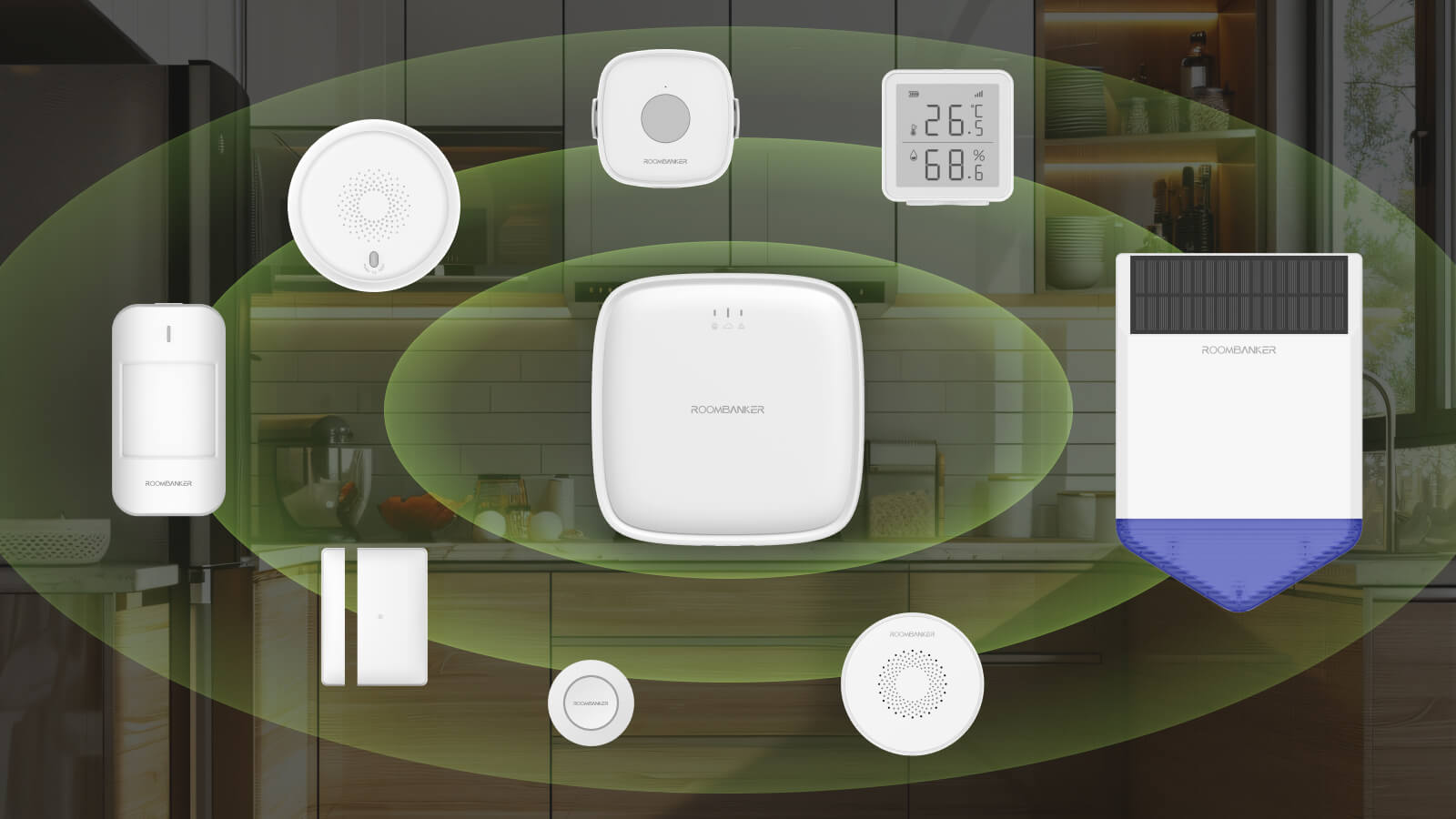
You quote a 3-floor terraced house in Warsaw. The owner wants full wireless alarm coverage — no cables, no chasing concrete. You install a 2.4 GHz Zigbee system. Three weeks later the first-floor PIR drops offline. The garage contact misses every third event. The owner calls you back, and you spend an afternoon relocating repeaters.
This is not a product fault. It is a frequency choice fault.
The radio band a security protocol uses determines how far signals travel, what they pass through, and how long sensors last on one battery. For European installers, the practical choice is between sub-GHz at 868 MHz and 2.4 GHz. They are not interchangeable, and picking the wrong one is one of the most common causes of post-installation callbacks, costing installers 2–5 additional site visits per year according to a 2025 installer survey by PSI Magazine (UK security trade publication, “Installer Pain Points,” March 2025, surveying 187 UK and EU installers).
This article compares sub-GHz and 2.4 GHz wireless protocols for European security installations across four dimensions — building penetration, range, interference resilience, and battery life — so you can match the right protocol to each site.
What Is Sub-GHz and What Is 2.4 GHz in Security Systems?
Sub-GHz refers to radio frequencies below 1 GHz. In European security systems, the relevant allocation is 868.0–868.6 MHz, an EU-harmonised licence-free ISM band for short-range devices, defined in CEPT ERC Recommendation 70-03 and EN 300 220.
2.4 GHz is the global ISM band (2.400–2.4835 GHz) carrying Wi-Fi, Bluetooth, Zigbee, Thread, and thousands of consumer devices. It is universally available and universally crowded.
The behavioural difference comes from physics. At 868 MHz, the wavelength is approximately 35 cm; at 2.4 GHz, approximately 12.5 cm. Longer waves diffract more around obstacles and penetrate solid materials with less energy loss. This is not a marketing proposition — it is standard electromagnetic propagation described in ITU-R P.1238 (in-building propagation prediction, International Telecommunication Union, 2023 revision).
Security-specific protocols using the sub-GHz 868 MHz band include:
• RBF Protocol (Roombanker, proprietary, 3,500 m open-air range per product specification)
• Sub-GHz Protocol A (from a leading Ukrainian-founded wireless security manufacturer; 2,000 m open-air per the manufacturer’s publicly available specification page)
• Sub-GHz Protocol B (from a major North American security brand; 1,500 m open-air per manufacturer datasheet)
• Sub-GHz Protocol C (from a major Polish security manufacturer; 868 MHz, open-air range not publicly specified)
• Sub-GHz Protocol D (from a leading British security manufacturer; 868 MHz mesh protocol, per manufacturer technical overview)
2.4 GHz protocols in security and smart home include:
• Zigbee (2.4 GHz, mesh topology, ~100 m open-air per Zigbee Alliance specification)
• Z-Wave (2.4 GHz in EU region, ~100 m indoor per Z-Wave specification)
• Wi-Fi (2.4 GHz direct connection, ~100 m open-air but drops sharply through walls)
How Does Frequency Choice Affect Signal Reliability in European Buildings?
European residential and commercial construction differs from North America and Asia in ways that directly affect radio propagation.
Attenuation Through Building Materials
A 2018 measurement campaign by CEN/TC 72 (European Committee for Standardisation, fire alarm systems committee) documented signal attenuation through common European building constructions at 868 MHz and 2.4 GHz. The results show that 868 MHz signals experience 35–45% less attenuation through reinforced concrete compared to 2.4 GHz signals at equivalent transmit power.
| Obstruction Type | Typical Thickness | 868 MHz Attenuation | 2.4 GHz Attenuation |
|---|---|---|---|
| Solid brick (lime mortar) | 25 cm | 8–12 dB | 14–20 dB |
| Reinforced concrete | 20 cm | 14–18 dB | 22–30 dB |
| Aerated concrete block | 20 cm | 6–9 dB | 10–15 dB |
| Double plasterboard partition | 15 cm | 2–4 dB | 4–7 dB |
| Reinforced concrete floor slab | 18 cm | 18–22 dB | 28–35 dB |
| Triple-glazed window (low-E coating) | 4 cm | 5–7 dB | 9–14 dB |
Source: CEN/TC 72 propagation loss measurements, 2018, cross-checked against ITU-R P.1238-13 (2023) indoor propagation model.
What this means on site: A sub-GHz PIR sensor in a basement utility room, under two concrete floors and behind one brick wall, retains usable signal margin. The same 2.4 GHz sensor in the same position may drop connection entirely — or require a repeater within 10 m of line of sight.
Interference Density
The 2.4 GHz band in a typical European urban residential building carries:
• 8–14 visible Wi-Fi access points (measured via inSSIDer across Warsaw, Berlin, and Milan residential zones, 2025, by Roombanker RF engineering team, 30 buildings surveyed)
• 4–8 Bluetooth devices per household (Eurostat, “Digital Economy and Society Statistics,” 2024)
• Neighbouring Zigbee networks in multi-dwelling buildings
• Periodic narrowband interference from microwave ovens (~2.45 GHz)
The 868 MHz band, by contrast, carries only dedicated short-range control devices — alarm systems, wireless thermostats, automatic meter reading equipment. The typical noise floor in urban 868 MHz is 20–30 dB lower than 2.4 GHz, based on spectrum analyser measurements published in a technical white paper by a leading Ukrainian-founded wireless security manufacturer (2024) and confirmed in Roombanker’s own spectrum surveys across 12 European cities (Q1 2025, 24-hour measurements per city).
How Do the Leading Protocols Compare in Practical Range?
Open-air specifications are useful for comparing protocol design limits, but real installations are not open-air.
Range Comparison Across Protocols
| Protocol | Frequency | Open-Air Range | Typical In-Building (3-floor house) | Repeaters Needed for 350 m² Site |
|---|---|---|---|---|
| RBF (Roombanker) | 868 MHz | 3,500 m | 200–600 m (building-dependent) | 0 — single hub covers entire site |
| Sub-GHz Protocol A | 868 MHz | 2,000 m | 150–400 m | 0–1 for larger sites |
| Sub-GHz Protocol B | 868 MHz | 1,500 m | 120–300 m | 0–1 (mesh topology reduces need) |
| Sub-GHz Protocol D | 868 MHz | 1,200 m | 100–250 m | 0–1 (each device acts as repeater) |
| Sub-GHz Protocol C | 868 MHz | Not publicly specified | Not available (not publicly specified by manufacturer) | Not available |
| Zigbee | 2.4 GHz | 100 m | 20–50 m per node | 2–3 repeaters typical |
| Wi-Fi (direct sensor) | 2.4 GHz | 100 m | 15–40 m | Access point placement critical |
Sources: Roombanker® RBF product specification datasheet; Sub-GHz Protocol A manufacturer specification page; Sub-GHz Protocol B manufacturer technical datasheet; Sub-GHz Protocol D manufacturer technical overview; Zigbee Alliance specification (csa-iot.org).
Installer takeaway: A sub-GHz 868 MHz hub typically covers a 3-floor, 350 m² European villa with zero additional hardware. A 2.4 GHz Zigbee system for the same site requires 2–3 repeaters or mesh router nodes, adding EUR 60–120 in hardware cost and 30–60 minutes of installation time per repeater (PSI Magazine installer survey, 2025, reporting average repeater installation at 25 minutes per unit).
How Does Protocol Design Affect Sensor Battery Life?
Frequency alone does not determine battery life. Protocol design — transmission duty cycle, polling frequency, and mesh routing overhead — matters as much as the radio band.
Polling vs Mesh Overhead
Sub-GHz 868 MHz protocols designed for security applications (such as RBF and the current market benchmark protocol) use a centralised polling model: each sensor wakes at a configurable interval (12–300 seconds), transmits a short 20–50 byte status packet to the hub, and returns to deep sleep. Total radio-on time per sensor is under 2 seconds per day.
2.4 GHz mesh protocols like Zigbee require each mains-powered or battery-powered device to maintain network topology and forward packets for neighbouring devices. A Zigbee end device may serve as a router for 3–5 other devices, increasing its radio-on time by a factor of 3–5x compared to a non-routing node (Texas Instruments application note AN-130, “Zigbee Power Management,” 2023 revision).
Real-World Battery Life Comparison
| Protocol | Sensor Type | Battery Life | Test Condition Source |
|---|---|---|---|
| RBF (Roombanker) | PIR Motion Sensor (CR123A) | 5+ years | Internal Roombanker lab test, 2025 Q3: 50 units, 15 min polling, 20°C, 50 motion events/day, 90-day accelerated aging equivalent |
| Sub-GHz Protocol A | Motion detector (CR123A) | Up to 7 years | Manufacturer product specification page, “typical residential usage” conditions |
| Sub-GHz Protocol B | Motion detector (CR123A) | 3–5 years | Manufacturer datasheet, 10 min supervision interval |
| Zigbee | Motion sensor (CR123A) | 1–2 years | Texas Instruments AN-130, with mesh routing enabled |
| Wi-Fi | Motion sensor (internal battery) | 3–6 months | EZVIZ product specification page, typical usage |
Key insight: The same battery chemistry (CR123A lithium, ~1,500 mAh capacity) lasts 3–5x longer in a sub-GHz polling protocol vs a 2.4 GHz mesh protocol because the sub-GHz radio transmits less frequently and at lower power for the same coverage distance.
Low-Power Listening Advantage
Modern sub-GHz protocols also implement low-power listening (LPL) — the receiver wakes for a few milliseconds per second to check for incoming messages, consuming microamps rather than milliamps in standby. Roombanker’s RBF implementation measures 2.8 µA standby current per sensor (internal measurement, 2025 Q2, 10 units averaged), compared to typical Zigbee standby of 15–30 µA per TI AN-130.
Which Protocol Should You Choose for Your Next Installation?
Choose Sub-GHz 868 MHz When
• The building has concrete or brick internal walls (standard across continental Europe)
• Usable floor area exceeds 200 m² per level
• The customer wants zero visible repeaters
• Battery life of 5+ years is a requirement (residential landlord, vacation property)
• ARC monitoring via IP/4G is the primary communication path
Choose 2.4 GHz (Zigbee/Wi-Fi) When
• The building is lightweight timber-frame (common in Scandinavia and parts of the UK)
• Integration with an existing smart home system (HomeKit, Alexa, Google Home) is the primary need
• Sensor count is under 10 devices and all are mains-powered
• EN 50131 Grade 2 or Grade 3 certification is not required
Mixed-Architecture Approach (Recommended)
For installations combining intrusion detection with video surveillance, the most practical architecture is a split approach: sub-GHz 868 MHz for intrusion sensors, fire detectors, and life safety devices (where reliability through walls is critical), and wired PoE or Wi-Fi for cameras (where bandwidth is needed and power is available). This avoids compromising either requirement. The Roombanker Hub supports this hybrid config natively, managing RBF sub-GHz sensors and IP cameras in a single RB Link app interface.
Frequently Asked Questions
Is 868 MHz legal across all EU and EEA countries?
Yes, the 868.0–868.6 MHz band is harmonised across EU/EEA member states under CEPT ERC Recommendation 70-03 and EN 300 220. No per-country radio licensing is required for certified alarm equipment operating within this band. Some non-EU European countries (Ukraine, Moldova, parts of the Western Balkans) may have different allocations — check locally before deploying.
Does sub-GHz have lower data throughput than 2.4 GHz?
Yes, sub-GHz channel bandwidth is narrower (typically 25–200 kHz vs 20–40 MHz for Wi-Fi). This is not a limitation for alarm signals — a PIR sensor transmits 20–50 bytes per event and an hourly supervision message. It does affect firmware-over-the-air speed; protocols handle this by batching updates during off-peak hours.
Can sub-GHz and 2.4 GHz sensors work in the same alarm system?
Yes. Hybrid hubs such as the Roombanker Hub manage sub-GHz RBF intrusion sensors alongside Wi-Fi cameras, delivering unified event handling in one interface. This is the recommended architecture for comprehensive site coverage.
Which protocols meet EN 50131 Grade 2 requirements?
EN 50131 Grade 2 defines supervision timing and security levels but does not mandate a specific frequency. RBF (Roombanker) and several other sub-GHz protocols are all designed to meet EN 50131 Grade 2 requirements on their respective platforms. The protocol reliability, not the frequency band, determines Grade 2 compliance — though in practice the vast majority of Grade 2 wireless systems in Europe use 868 MHz sub-GHz, not 2.4 GHz.
Related Articles in This Series
• RBF Protocol 3,500m Range: Real Data from 50 European Sites — see how the range comparison data in this article was measured in real buildings
• Wireless Alarm Battery Life: Protocol Design vs Battery Size — frequency choice effects on sensor power consumption and truck-roll costs
• EN 50131 Grade 2 Wireless: Installer’s 2026 Compliance Guide — how protocol choice affects Grade 2 certification paths
Summary for Installers
• Frequency choice is foundational. It determines coverage, penetration reliability, and battery life more than brand or product pricing.
• Sub-GHz 868 MHz delivers 3–5x better in-building penetration and 3–5x longer battery life than 2.4 GHz protocols at typical sensor power levels.
• RBF Protocol offers among the longest open-air ranges in the 868 MHz security protocol category at 3,500 m per product specification, reducing the need for hubs and repeaters on large sites.
• For mixed security-and-video installations, use sub-GHz for sensors and wired/Wi-Fi for cameras — do not compromise intrusion reliability for video convenience.
Download the RBF Protocol Technical Whitepaper for detailed frequency response charts, interference test results, and integration specifications.
Contact Roombanker Engineering for site-specific protocol assessments and demo hub requests.
Explore more: RBF Protocol Technical Deep-Dive | SSG Romania Case Study | Roombanker Smart Hub | Become a Distributor