
Security distribution is an attractive business model for entrepreneurs with existing relationships in the security or construction industries. But the specific economics, operational requirements, and risks are not always obvious from the outside.
This FAQ answers the 15 most common questions we receive from business owners considering entering security distribution, with a focus on the Mediterranean market. For the foundational context, we recommend reading our earlier articles on building a security distribution business, distributor economics and margins, and recruiting and managing installer networks.
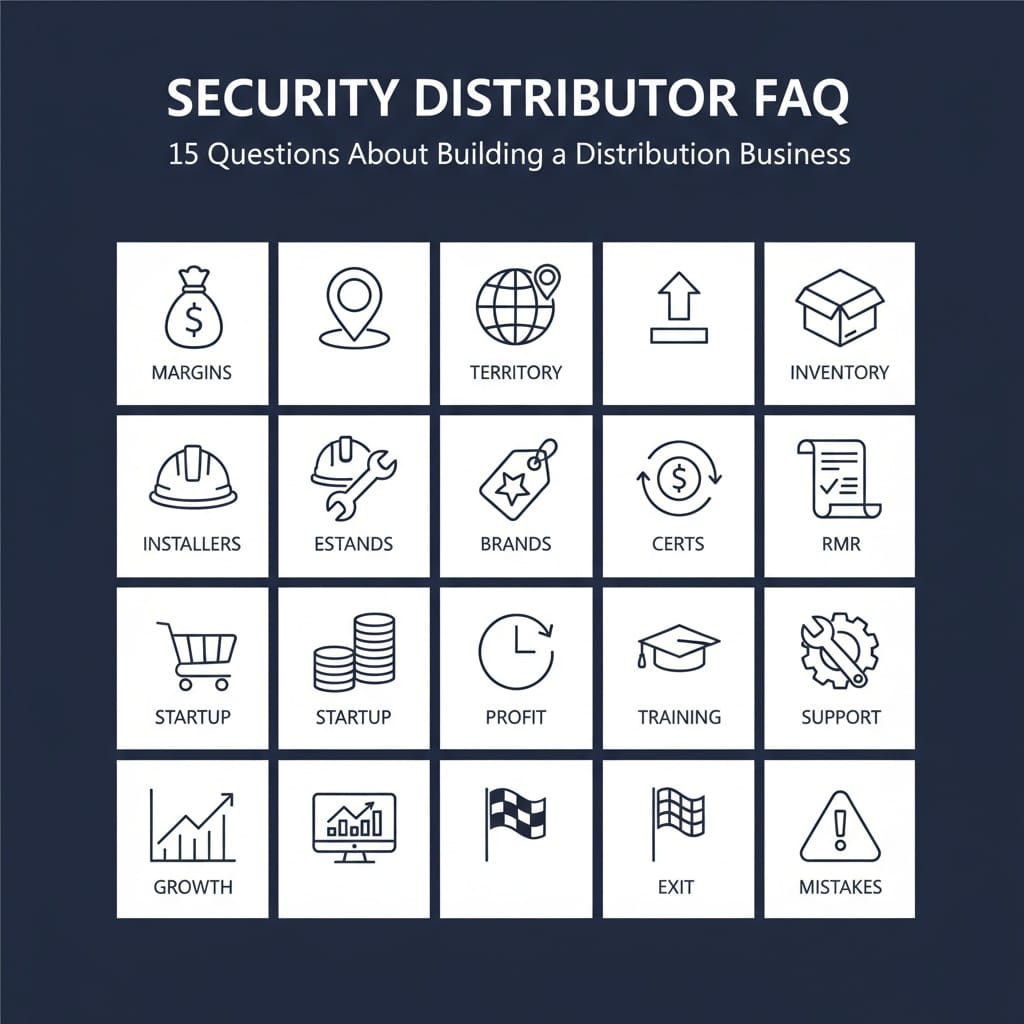
Q1: What profit margins can I expect as a security equipment distributor?
Typical gross margins in security distribution range from 20% to 40% depending on the product category and brand. Sub-Ghz alarm systems from premium brands typically offer 25–35% distributor margin. Access control and video surveillance tend to be slightly lower at 20–30%. Consumables like cables and brackets offer 30–50% but lower absolute value. The key to healthy margins is negotiating exclusive or semi-exclusive distribution rights — the One Country One Distributor model provides the strongest margin protection, as it prevents cross-border competition and online price erosion.
Net margins after operating expenses (warehouse, staff, logistics, marketing) typically settle at 5–15% for established distributors.
Q2: Do I need exclusive territory rights to be profitable?
Not strictly, but exclusive or semi-exclusive territory rights significantly improve the probability of long-term profitability. Without territory protection, you compete against other distributors selling the same brands, which drives margin compression. The One Country One Distributor model, where a single distributor represents a brand in a country, eliminates intra-brand competition and allows the distributor to invest in brand building, installer training, and local stock without fear of another distributor free-riding on those investments.
If a brand offers open distribution, factor margin erosion into your business plan and keep inventory lean.
Q3: How much inventory do I need to carry?
Initial inventory for a security distribution start-up typically requires EUR 50,000–200,000 depending on the number of product lines and target service level. A reasonable starting point is to stock 3 months of forecasted demand for core products (panels, detectors, sirens, keypads) and 1–2 months for accessories and consumables. Most manufacturers offer initial stocking orders at improved pricing. Avoid overstocking slow-moving lines — negotiate consignment or drop-ship terms for niche products until demand is proven.
As you grow, inventory turns of 4–6 per year are considered healthy in security distribution.
Q4: How do I recruit installers to buy from me?
Installer recruitment is the most important and most difficult part of building a security distribution business. Effective approaches include:
• Direct outreach: Visit local security installation companies. Bring a demo kit. Offer a first-order discount.
• Training events: Host free half-day training sessions on new products. Installers attend to learn and often stay to buy.
• Existing relationships: Leverage your network from adjacent industries (electrical wholesale, building materials, IT).
• Trade shows: Attend Expoproteccion, MIPS, or local security exhibitions.
• Referral programmes: Offer existing installer customers a discount or credit for each new installer they introduce who places an initial order.
The key is to make the first transaction easy — low minimum order, extended payment terms on the first order, and hands-on support during the first installation.
Q5: How do I choose which brands to distribute?
Evaluate potential brands against these criteria:
1. Market demand: Is there proven demand in your country, or will you be creating it?
2. Margin structure: Does the brand’s pricing leave room for both distributor and installer margin?
3. Territory protection: Will you be the exclusive distributor, or will you compete with others?
4. Certification: Does the portfolio carry EN 50131 and local certifications needed in your market?
5. Support: Does the manufacturer provide technical training, marketing materials, and sales support?
6. Product breadth: Is the catalogue complete enough to serve a range of installation types?
7. Brand trajectory: Is the brand growing or established? Growing brands offer more upside but less immediate pull. Established brands offer instant recognition but tighter margins.
Carry 2–4 complementary brands rather than 10+. Depth of inventory and expertise in fewer lines beats breadth with shallow stock.
Q6: What certifications do I need to distribute security equipment?
In most Mediterranean countries, you do not need specific licences to distribute security equipment as a wholesale business. However, you should understand your customers’ certification requirements:
• Installers may need EN 50131 certification for systems they install (Grade 2 for residential, Grade 3 for commercial/high-risk).
• Fire detection products may have additional regulatory requirements.
• Importing from outside the EU requires CE marking and may require additional customs documentation.
• GDPR compliance is required if you handle any end-customer data through monitoring or cloud services.
You do not need to certify your business — you need to stock certified products so your installer customers can sell compliant installations.
Q7: How much capital do I need to start?
A security distribution business can be started with EUR 80,000–250,000 depending on location and scale:
• Inventory (initial stock order): EUR 50,000–150,000
• Warehouse (3 months rent + deposit): EUR 10,000–20,000
• Fixtures and equipment: EUR 10,000–15,000
• Website and systems: EUR 5,000–15,000
• Working capital (3 months operating expenses): EUR 20,000–50,000
• Legal and registration: EUR 2,000–5,000
Start-up costs are significantly lower if you operate from existing premises (e.g., adding a distribution line to an existing electrical or security installation business).
Q8: How long until the business is profitable?
Most security distribution businesses reach month-to-month operating profitability within 6–12 months of launch and recover the initial investment within 18–36 months. Key factors that accelerate profitability:
• Starting with an existing customer base (e.g., cross-selling to existing electrical contractor customers)
• Securing exclusive distribution that protects margins
• Focusing on consumable and repeat-purchase products early (batteries, cables, brackets) alongside big-ticket alarm systems
• Keeping overhead lean — a distributor can operate effectively with 1–2 staff for the first 12–18 months
Q9: Can I build recurring monthly revenue (RMR) as a distributor?
Yes, but the model depends on the product and market. In security distribution, RMR opportunities include:
• Monitoring services: Some manufacturers share ARC monitoring revenue with the distributor who on-boarded the installer and end customer.
• Cloud subscriptions: Cloud-based alarm platforms generate monthly or annual subscription fees, which can be split between the manufacturer, distributor, and installer.
• Extended warranty programmes: Distributors can offer extended warranties on hardware at a margin.
• Consumable replenishment: Batteries, cables, and mounting accessories generate repeat orders.
RMR typically accounts for 5–15% of a traditional distributor’s revenue but a higher percentage of profit. Building RMR diversifies your business away from being purely transactional.
Q10: How do I compete with online retailers selling security equipment?
Online competition is real and growing. Strategies to compete effectively:
• Stock exclusivity: Brands that sell directly on Amazon or Leroy Merlin will always be price-compared. Choose brands that maintain exclusive professional distribution channels.
• Value-add services: Online retailers cannot offer hands-on product training, technical support, or installation troubleshooting. Emphasise these services.
• Bundling: Create installer kits that combine panel, detectors, and accessories at a bundled price that is difficult to compare item-by-item online.
• Stock availability: Online retailers frequently stock only fast-moving lines. If you stock the full catalogue, installers will come to you for everything.
• Credit terms: Offer 30–60 day payment terms to established installer customers that online retailers cannot match.
Q11: What training do I need to provide to installer customers?
As a distributor, you should provide at minimum:
• Product training: Free half-day or full-day sessions on installing and configuring the systems you sell. Include hands-on lab time with the installer app.
• Technical support: Phone or chat support during business hours for installation and troubleshooting questions.
• Sales training: Guidance on how to quote wireless vs wired, how to present the value proposition to end clients, and how to handle objections about wireless reliability.
• Certification support: Help installers navigate the EN 50131 certification process if required for their market.
Manufacturers vary greatly in the quality and availability of training materials. Choose a brand that provides ready-made training content in local languages.
Q12: What level of technical support can I expect from the manufacturer?
A good manufacturer provides:
• Dedicated distributor account manager
• Field application engineer available for site visits (at least quarterly)
• Technical knowledge base and installer portal
• RMA process with advance replacement option
• Marketing materials (brochures, website content, social media assets) in local languages
• Joint business planning with quarterly performance reviews
If a manufacturer cannot commit to these, and particularly if they have no local presence in your region, factor the cost of providing your own first-line support into your business plan.
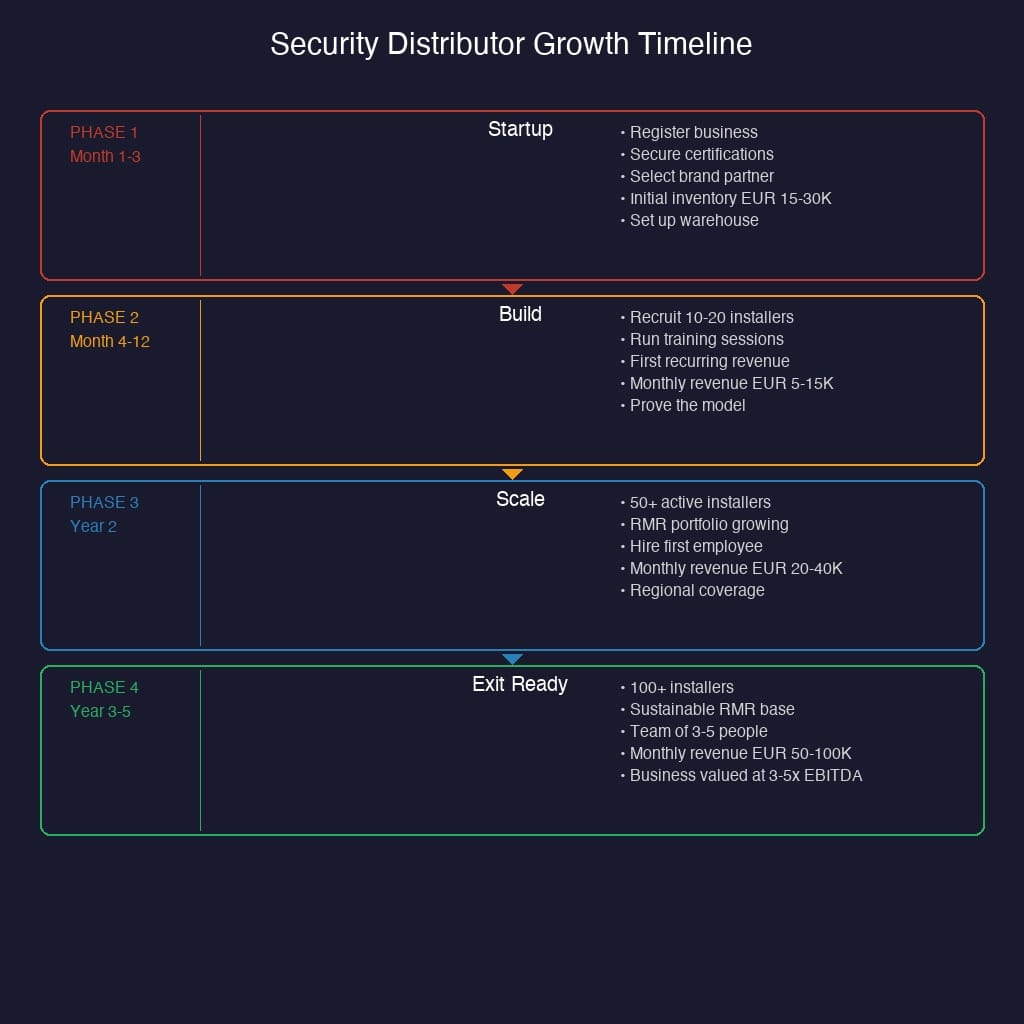
Q13: What is a realistic growth timeline for a security distribution business?
A realistic growth trajectory for a focused security distributor:
• Year 1: Establish supply chain, recruit 10–20 active installer customers, build local stock, EUR 200K–500K revenue.
• Year 2: Grow installer base to 30–60, add complementary product lines, expand warehouse capacity, EUR 500K–1.2M revenue.
• Year 3: Recruit 60–100 installers, consider second country or region expansion, EUR 1M–2.5M revenue.
• Year 5: 100–200 active installer customers, multiple product lines, stable management team, EUR 2M–5M revenue.
These figures are indicative. Actual results depend heavily on market size, competitive landscape, and brand traction.
Q14: What is the exit strategy for a security distribution business?
Common exit paths include:
• Trade sale to a larger distributor: Larger regional or pan-European distributors frequently acquire successful country-level distributors to expand their footprint. Valuations typically range from 3–6× EBITDA.
• Management buyout: A senior employee or management team buys the business over a 3–5 year period.
• Manufacturer acquisition: Some manufacturers eventually acquire their best distributors to establish direct market presence. This is more common with growth brands than mature ones.
• Organic growth and dividend: Many security distributors remain independent and profitable indefinitely, providing a solid income for the owner.
Exclusive distribution rights add significant value in any exit scenario, as the acquirer cannot simply switch to a different supplier.
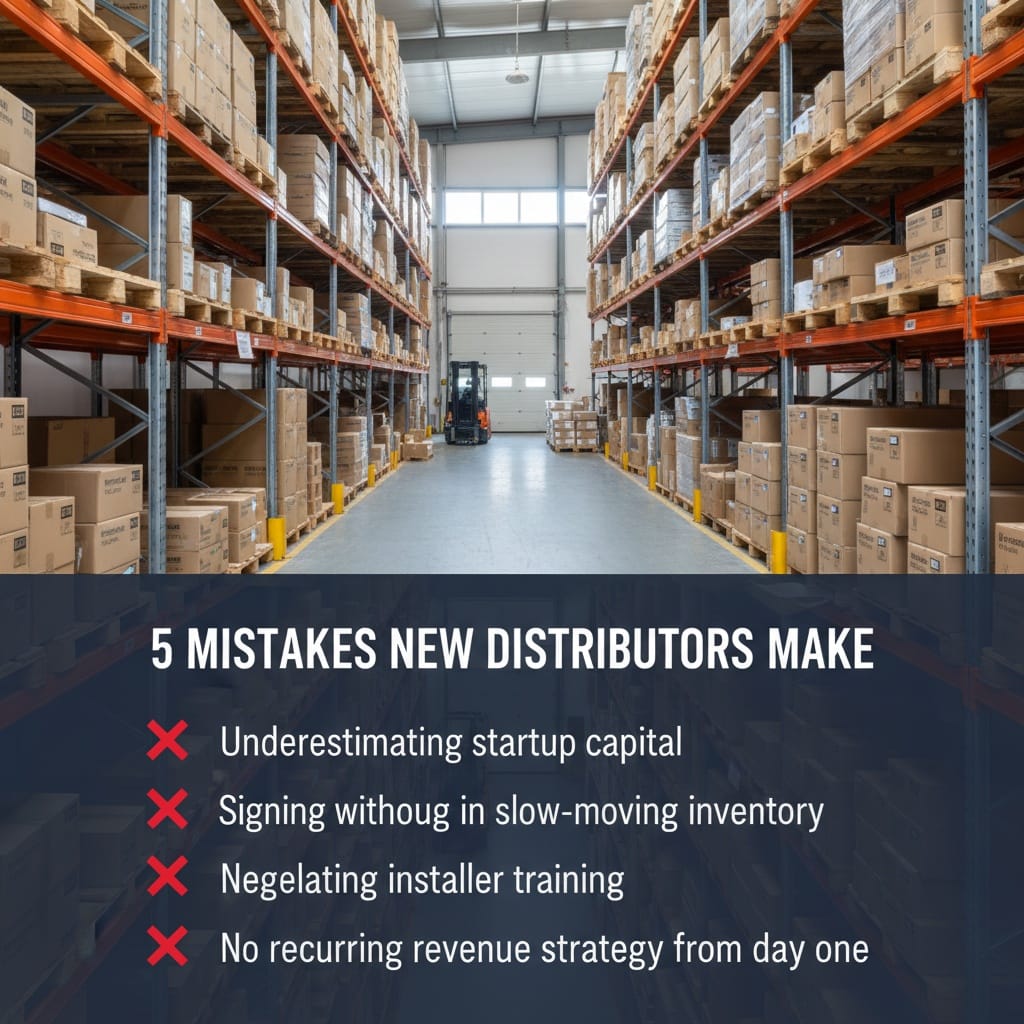
Q15: What mistakes do new security distributors most commonly make?
1. Carrying too many brands: Lack of focus means insufficient depth in any single line. Installers need a distributor who knows the products inside out.
2. Underestimating technical support burden: First-line support is time-consuming. Factor full-time support staff into headcount planning earlier than you think necessary.
3. Neglecting inventory management: Either overstocking slow movers or understocking fast movers. Both cost money and credibility.
4. No territory protection: Selling brands that are available from multiple sources in your market guarantees margin erosion over time.
5. Ignoring the installer relationship: The installer is your customer, not the end user. Treating installer recruitment and retention as secondary to supplier relationships is a common error.
6. Underpricing services: Free delivery, free training, free support, extended credit — all of these have costs. Build them into your pricing model transparently.
Roombanker operates a One Country One Distributor model with exclusive territory rights, comprehensive installer training, technical support, and EN 50131 Grade 2 and Grade 3 certified products purpose-built for the Mediterranean market. For more on the distributor opportunity, read our series: starting a security distribution business, distribution economics and margins, and building your installer network. Contact us to discuss distributor opportunities in your country.