
A PIR motion detector does not see people, pets, or objects in the way a camera does. It does not create an image, recognize a face, or understand identity. Instead, it reacts to changes in infrared energy across its detection area.
This distinction matters because many false alarms start from the same misunderstanding. A PIR detector is not deciding, “Is this a person?” in a visual sense. It is interpreting changes in heat patterns and deciding whether those changes are likely to match an alarm condition.
Thermal interference filtering is not one magic algorithm. It is a signal interpretation process that combines hardware input, detection zones, signal strength, movement timing, and environmental context. In a professional security detector, the goal is not to eliminate every false alarm, but to reduce unwanted triggers while still detecting real human movement reliably.
What Is a PIR Motion Detector Algorithm?
A PIR motion detector algorithm is the logic used to process the signal from a passive infrared sensor. The PIR sensor responds when infrared energy changes within its field of view. The algorithm then evaluates that signal and decides whether the pattern should be treated as motion.
This does not mean the detector is identifying a person like a camera. A typical PIR detector does not know whether the heat source is a person, pet, curtain, heater, or sunlight reflection. It only receives electrical changes caused by infrared variation.

The algorithm may consider factors such as:
- How strong the infrared change is
- How the change moves across detection zones
- How long the change lasts
- Whether the signal looks stable or noisy
- Whether the pattern fits the expected behavior of human-like movement
Different products use different detection logic, sensor designs, and filtering methods. This article explains general PIR algorithm principles only, not the capability of any specific product.
What Is Thermal Interference in PIR Detection?
Thermal interference refers to infrared changes that are not caused by a real intrusion but may still affect the PIR sensor.
Common sources include:
- Direct sunlight or reflections
- Heaters, fireplaces, and radiators
- HVAC airflow
- Warm curtains moving near a window
- Pets moving through the detection area
- Insects close to the lens
- Rapid indoor temperature changes
- Outdoor heat movement from pavement, walls, or vegetation
These sources can confuse a PIR detector because PIR technology responds to infrared changes, not object identity. A warm object moving across a detection zone may create a signal. A sudden heat reflection may also create a signal. Even a small insect close to the lens can sometimes create a strong local disturbance because it is very near the sensing path.
Thermal interference filtering is designed to reduce these unwanted triggers. It does this by evaluating the pattern of the signal, not by visually confirming what caused it.
How PIR Sensors Read Thermal Patterns
A PIR detector usually works with a Fresnel lens or similar optical structure that divides the protected area into multiple detection zones. These zones help shape how infrared energy reaches the PIR sensor.
When a warm body moves across the detection area, it passes through different zones. This creates a changing signal. The detector does not see a body shape, but it may detect a sequence of infrared changes as the heat source moves.
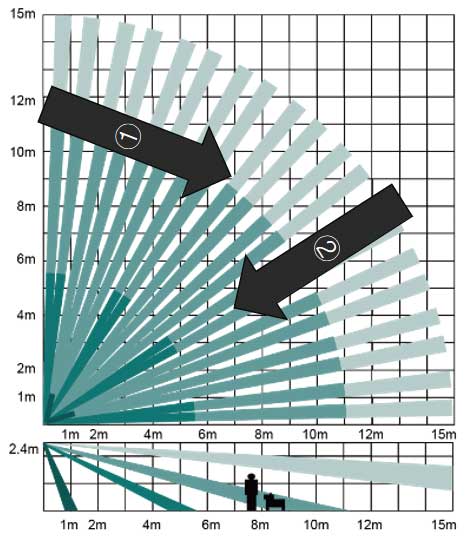
In many cases, human movement creates a larger and more consistent thermal transition than small pets or random heat noise. A person walking across a room may affect several zones in a more organized pattern. A curtain moving in warm air may create a softer or less consistent change. An insect near the lens may create a sharp but localized disturbance.
These are general tendencies, not absolute rules. Real environments are complex. The algorithm may use zone transitions as one signal among several, but it cannot perfectly identify the source of every thermal change.
Signal Strength: How Strong Is the Infrared Change?
Signal strength refers to the amplitude of the infrared change detected by the PIR sensor. A larger temperature contrast or a larger moving heat source may produce a stronger signal. A smaller object or weaker temperature contrast may produce a weaker signal.
However, signal strength alone is not enough.
A strong signal does not always mean real intrusion. Direct sunlight reflecting onto a surface, a heater turning on, or a warm airflow pattern may also create a strong change. At the same time, a weak signal does not always mean nothing happened. A person far from the detector, moving slowly, or moving in a low-contrast environment may create a less obvious signal.
This is why PIR filtering may evaluate signal strength together with timing, movement direction, zone transitions, and environmental behavior. The signal must be interpreted as a pattern, not only as a single peak.
Thermal Spot Size: How Large Is the Moving Heat Source?
Thermal spot size is a practical way to describe how much of the detection pattern is affected by a moving heat source. This does not mean the algorithm knows the true physical size of an object. It means the signal may indicate whether the heat change affects a small part of the detection area or a broader section of the detection pattern.
For example, a person walking across several detection zones may create a broader thermal transition. A small pet moving close to the floor may affect a different part of the lens pattern. An insect very close to the lens may create a strong but very localized disturbance. A warm air current may create a soft or drifting change rather than a stable moving body pattern.
Advanced PIR algorithms may consider this kind of signal behavior to help distinguish human-like movement from environmental noise. But this is still signal interpretation. It is not visual recognition, and it is not guaranteed to separate every person, pet, or interference source correctly.
Movement Speed and Direction: How Does the Heat Source Move?
Movement speed and direction are important because intrusion movement often creates a sequence across detection zones.
A person walking through a room may produce a pattern that changes from one zone to another in a continuous way. The timing between these changes may help indicate movement across the protected area. By comparison, sunlight changes may be gradual or localized. HVAC airflow may drift. Curtains or plants may repeat movement in the same area. Pets may move at lower height and with less predictable paths.
A PIR algorithm may consider:
- Whether the signal moves across multiple zones
- Whether the movement has a consistent direction
- Whether the speed fits expected human movement
- Whether the signal appears random, repeated, or localized
These indicators can help reduce false alarms, but they are not absolute. A person can move slowly. A pet can move quickly. A curtain can create repeated motion. The algorithm must balance false alarm reduction with detection reliability.
Time in Detection Zone: How Long Does the Pattern Last?
Time is another important part of PIR signal interpretation. A detector may consider how long a thermal change remains in the detection area and how the signal develops over a short time window.
A very brief disturbance may come from an insect, a small reflection, or a quick local change. A longer movement pattern may be more consistent with a person moving through the space. A continuous heat source, such as warm airflow from a vent, may produce a different duration pattern again.
This does not mean longer always equals real motion, or shorter always equals false alarm. Duration is only one clue. A detector may combine dwell time with signal strength, zone transitions, movement direction, and other filtering logic.
The purpose is to avoid making an alarm decision from one unstable signal point. A more reliable decision usually comes from evaluating how the signal changes over time.
Common False Alarm Markers in Thermal Patterns
| Pattern source | Possible thermal marker | Why it can confuse PIR | What filtering may consider |
|---|---|---|---|
| Pet movement | Lower-height movement, smaller thermal spot, erratic path | A pet still emits infrared energy and can cross detection zones | Signal size, height-related lens pattern, movement path, duration |
| HVAC airflow | Soft, drifting thermal change | Warm or cold air may change infrared levels near surfaces | Stability, direction, duration, repeated environmental pattern |
| Sunlight or reflection | Gradual or sudden localized heat change | Reflected sunlight can heat surfaces or create sharp thermal contrast | Location, speed of change, whether the pattern moves like a body |
| Insects near the lens | Very close local disturbance | A small object near the lens can create a strong local signal | Signal shape, duration, localized behavior |
| Curtains or plants | Repeated non-human movement | Moving objects can shift warm or cool surfaces in the field of view | Repetition, limited zone transition, airflow-related timing |
| Human movement | Larger cross-zone thermal transition | A person may create a stronger and more continuous movement pattern | Multi-zone sequence, signal strength, timing, direction |
These markers are general engineering concepts. They are not strict identification rules. PIR detectors interpret infrared changes; they do not visually confirm the source.
Why Hardware Still Matters to Software Filtering
Software filtering depends on the quality of the input signal. Poor hardware input gives software noisy data.
The lens affects how the protected space is divided into detection zones. The PIR sensor affects how cleanly infrared changes are converted into electrical signals. The housing can help reduce unwanted light, dust, insects, and mechanical instability. The installation angle determines what the detector actually sees in the room or outdoor area.
If the lens pattern is poorly matched to the space, the algorithm may receive confusing signals. If the detector faces a heater, window, or moving curtain, the software has to interpret unnecessary thermal noise. If insects can enter the housing or move near the sensing path, local disturbances may become harder to filter.
This is why a PIR detector should be evaluated as a complete system:
- Lens and detection zone design
- PIR sensor quality
- Housing and environmental protection
- Temperature compensation
- Sensitivity settings
- Installation height and direction
- Walk testing and maintenance
Software matters, but it cannot fully compensate for poor placement, unstable hardware, or a difficult environment.

Can PIR Algorithms Eliminate False Alarms?
No. PIR algorithms can help reduce false alarms, but they cannot eliminate all false alarms in every environment.
A PIR detector works by interpreting infrared changes. Real environments include pets, sunlight, airflow, insects, heaters, windows, reflective surfaces, and changing temperatures. Some of these conditions can create signals that look similar to real movement, especially when installation is poor or sensitivity is not matched to the space.
Advanced filtering may improve decision quality by considering signal strength, thermal spot size, movement speed, time in detection zones, and environmental patterns. But no PIR algorithm can guarantee perfect separation between human movement and every possible source of thermal interference.
A practical approach is to combine good detector design with correct installation and testing. For professional selection, installers and system designers should check:
- Lens and detection zone design
- PIR sensor quality
- Temperature compensation
- Adjustable sensitivity
- Pet immunity with clear installation conditions
- Tamper protection
- Stable housing and insect protection
- Proper mounting height and direction
- Reliable system testing tools
- Clear installation documentation
- Certification requirements if the project needs them
The best results usually come from the full chain working together: hardware, software, installation, configuration, and maintenance.
FAQ
What does a PIR motion detector algorithm do?
A PIR motion detector algorithm processes infrared signal changes from the PIR sensor and decides whether the pattern is likely to match an alarm condition. It does not identify people visually like a camera.
What is thermal interference in a PIR detector?
Thermal interference is unwanted infrared change caused by sources such as sunlight, heaters, HVAC airflow, pets, insects, moving curtains, or rapid temperature changes. These changes may confuse a PIR detector because it reacts to infrared variation.
Can PIR sensors tell humans and pets apart?
A PIR sensor does not truly identify humans or pets. Some detectors may use signal patterns, installation height, lens design, and filtering logic to reduce pet-related false alarms, but this is not the same as visual recognition.
How do PIR detectors reduce false alarms?
They may reduce false alarms by analyzing signal strength, movement timing, detection zone transitions, thermal pattern size, sensitivity settings, and environmental noise. Proper installation and testing are also essential.
Does a PIR detector use a camera?
A standard PIR detector does not use a camera. It detects changes in infrared energy. It does not capture images, recognize faces, or understand object identity.
Can thermal interference filtering stop all false alarms?
No. Thermal interference filtering can help reduce false alarms, but it cannot stop all unwanted triggers in every environment.
Why do installation and lens design matter for PIR algorithms?
The algorithm depends on the signal it receives. Lens design shapes the detection zones, and installation determines what the detector monitors. Poor placement can create noisy or misleading infrared signals.
Is software more important than hardware in a PIR motion detector?
Software and hardware work together. Hardware provides the signal quality, while software interprets the signal. Good filtering depends on both, along with correct installation and testing.