
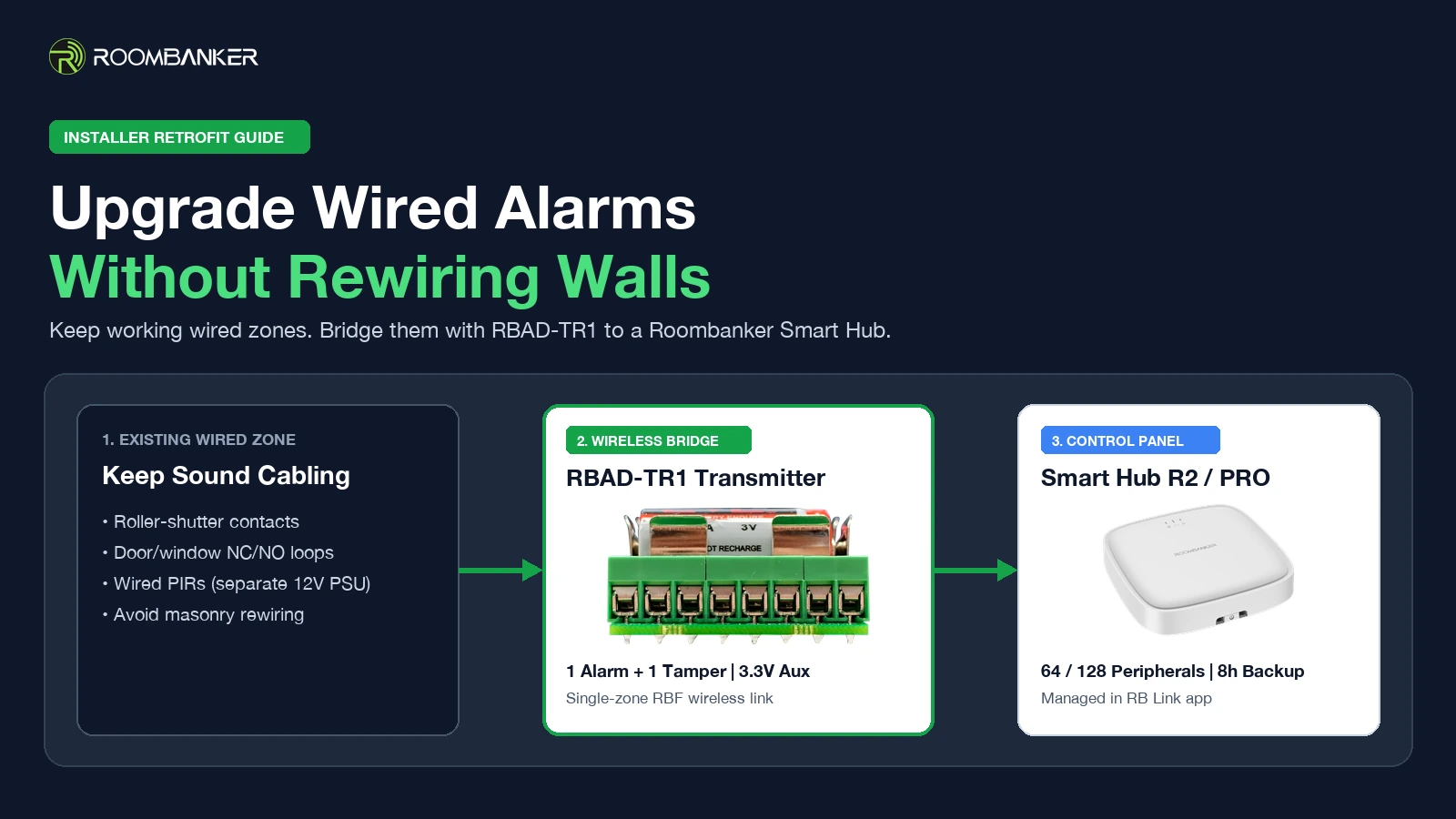
Ripping out working alarm cables adds labor and eats into your retrofit margin. You can retain compatible wired contacts, PIR alarm outputs, or roller-shutter switches and connect them to a modern wireless system through a single-zone transmitter like RBAD-TR1—saving wall repair and cable-pulling work on your client’s shop, office, or home upgrade.
For you as an installer, the real bottleneck in alarm upgrades is rarely the control panel. It is the cost and disruption of chasing masonry, lifting floorboards, or drilling finished storefronts just to replace a working wired zone.
Why Full Rewiring Kills Your Retrofit Margins
Small commercial sites—such as a corner pharmacy, a boutique retail store, a dental clinic, or a stockroom—already have hardwired door contacts, roller-shutter switches, or legacy PIR lines buried behind drywall or conduit. When the old control panel fails or loses 2G/3G cellular support, your client wants app control and reliable 4G/Ethernet reporting without disrupting trading for avoidable cabling work.
Quoting a full rip-and-replace makes your bid expensive and slow. Retaining sound existing wiring—and bridging compatible zones that pass electrical and functional checks—reduces cable-pulling and wall-repair work, helping you protect your labor budget and quote a more competitive upgrade.
How a Single-Zone Wired-to-Wireless Transmitter Works
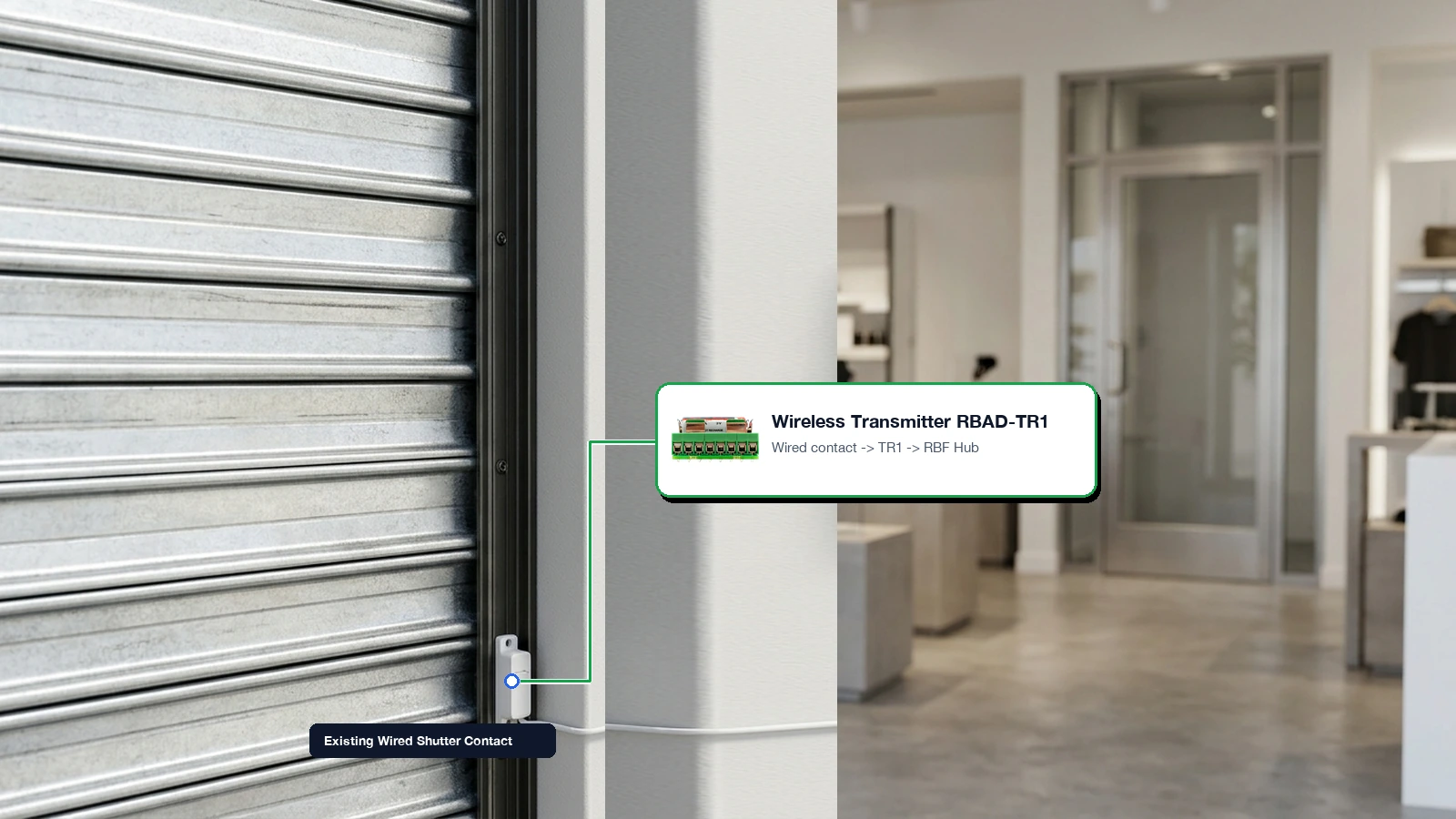
Instead of replacing every sensor on day one, you terminate the existing wired loop into a compact wireless bridge at the sensor or old panel location. For example, in a retail shop with a steel roller shutter at the front entrance, you wire the shutter’s existing contact directly into RBAD-TR1:
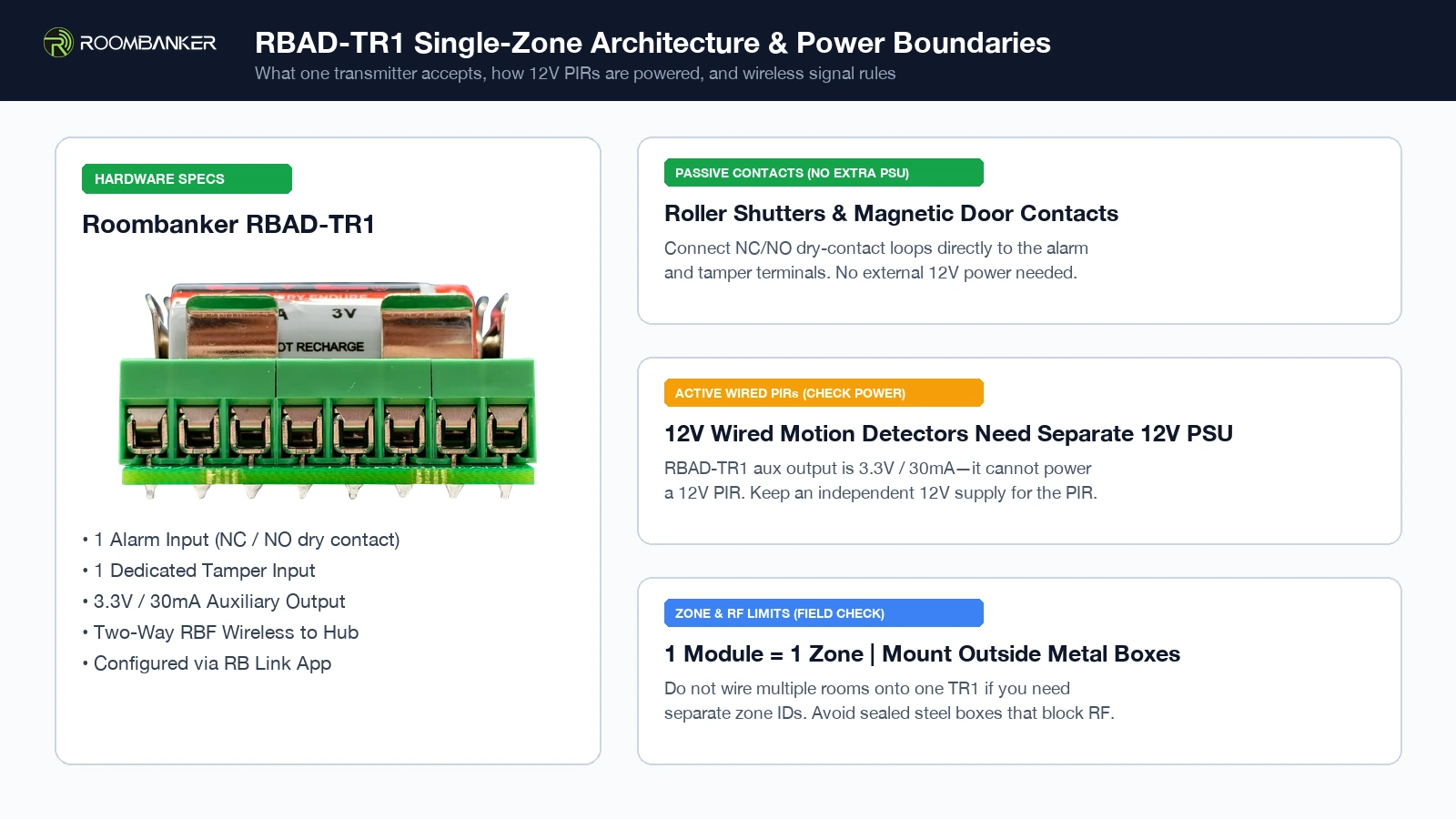
- 1 Alarm Input + 1 Tamper Input: Reads one compatible wired alarm contact and a separate wired detector tamper contact independently.
- 3.3V Auxiliary Output: Supplies up to 30mA for wired devices rated for that voltage and current.
- Two-Way RBF Wireless Link: Transmits encrypted alarm and tamper states wirelessly to a Roombanker Smart Hub (R2 or R2 PRO), managed from your RB Link app.
Because each Roombanker Wireless Transmitter (RBAD-TR1) handles one wired alarm zone plus tamper, you can selectively bridge high-value hardwired points—such as a heavy steel roller shutter, a rear fire exit, or an existing wired PIR—while adding new wireless Door Window Sensor G2 or indoor/outdoor PIRs everywhere else.
Will RBAD-TR1 Work with My Existing Wired Sensors?
RBAD-TR1 accepts compatible dry-contact alarm outputs using NC (normally closed) or NO (normally open) contact states. Each module has 1 alarm input + 1 tamper input: it handles a single alarm zone, not multiple independently identified zones. For example, if you need separate front-door and rear-shutter reporting, plan a module for each alarm zone.
For your existing powered PIR, check its supply rating and provide an independent 12V supply when required; the transmitter’s 3.3V auxiliary output cannot power a 12V detector. Match the detector’s dry-contact output, NC/NO state, tamper wiring and operating mode to the RBAD-TR1 specification before quoting. For an existing resistor-supervised loop, have the wiring reviewed against both devices’ instructions before reuse; the published specification lists NC/NO contact states without listing EOL/DEOL supervision.
Step-by-Step Field Checklist Before You Bridge an Old Zone
Some legacy cables are too worn to reuse. For instance, if a warehouse loading-bay cable shows corrosion or intermittent resistance, bridging it will only cause false alarms later. Before connecting RBAD-TR1, check the zone on site before committing it to your retrofit quote:
- Test loop continuity and resistance: Confirm your existing wired magnetic contact or roller-shutter switch opens and closes cleanly without intermittent cable breaks.
- Verify tamper integrity: Check whether the existing wired sensor has a dedicated tamper pair you can land on the RBAD-TR1 tamper input.
- Check RF signal to the Hub: Use the RB Link app signal test at your mounting spot before closing the housing—avoid mounting directly inside a sealed steel distribution box where metal shielding blocks RF.
- Test the connected zone: Trigger an alarm, restore the contact and operate the tamper switch; check that each expected event reaches your Hub and RB Link before closing the job.
When to Bridge vs. When to Replace with Native Wireless Sensors
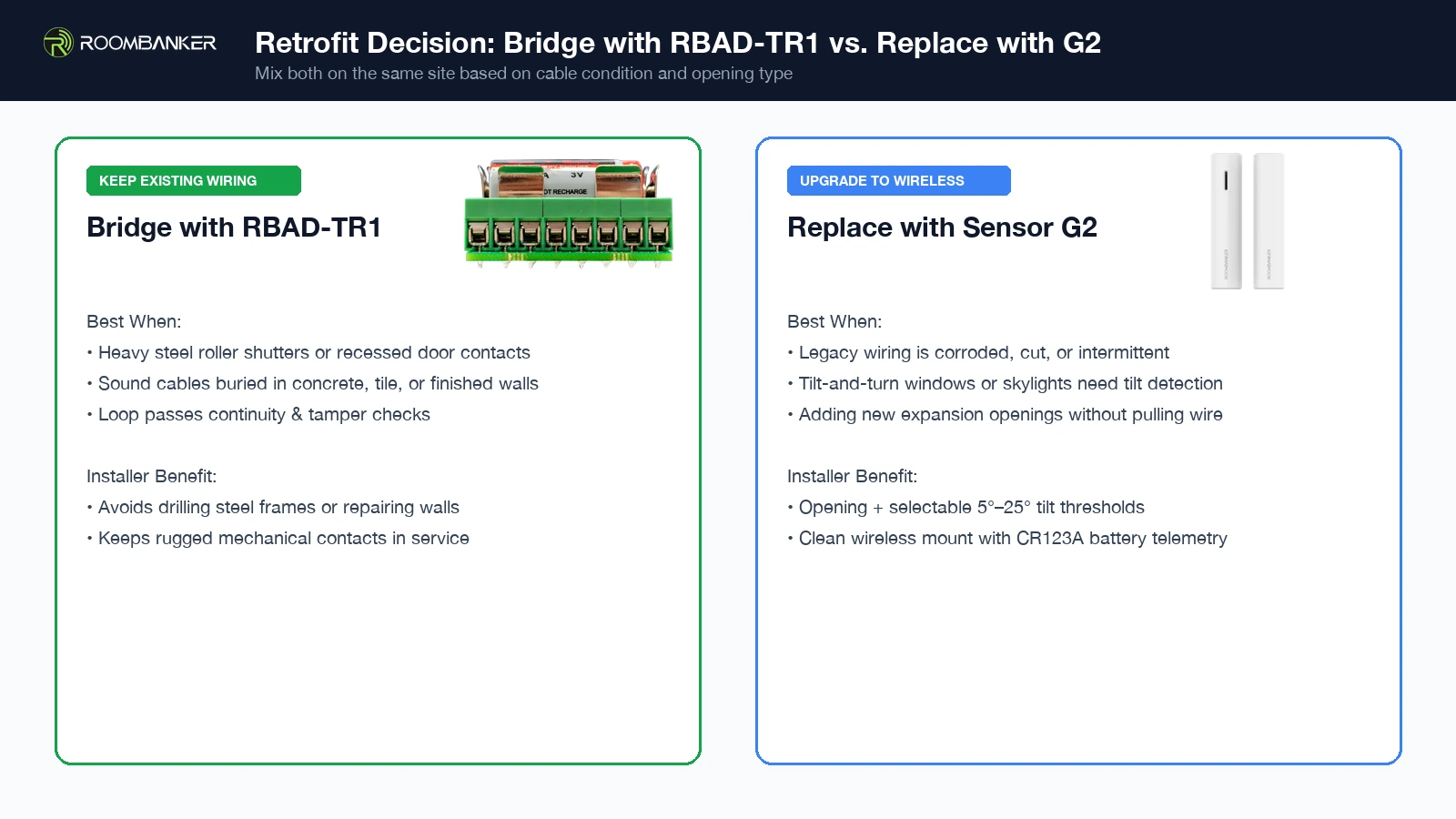
For example, when you walk into a tiled pharmacy with recessed steel door contacts and a damaged hallway PIR, you do not have to choose one method for the whole building:
| Scenario | Best Choice | Why |
|---|---|---|
| Working heavy-duty roller shutter or recessed steel-door contact | Bridge with RBAD-TR1 | Keeps rugged mechanical hardware intact without drilling steel frames |
| Legacy wired detector in a tiled, concrete, or finished retail wall | Bridge with RBAD-TR1 | Avoids wall repair and preserves clean aesthetics |
| Damaged wiring, corroded door/window contacts, or a need for tilt detection | Replace with Door Window Sensor G2 | Provides opening and configurable tilt detection (5°–25°) for indoor doors, windows and skylights |
| New expansion zones (skylights, glass doors, storage rooms) | Add native RBF wireless sensors | Faster mounting and full battery/signal telemetry in RB Link |
Retrofit FAQs
How many wired zones can one RBAD-TR1 handle?
One alarm zone plus one separate tamper input. Count each independently reported zone when you size your retrofit kit.
Can RBAD-TR1 power my existing 12V PIR?
Its auxiliary output is 3.3V, up to 30mA. Keep a suitable independent 12V supply for a PIR rated for 12V and connect its compatible dry-contact outputs.
Can I keep every old cable and detector?
Reuse compatible devices and sound wiring after testing. Replace damaged cable or unreliable contacts before they become a return visit.
Upgrade Legacy Sites Faster with Roombanker
Combining RBAD-TR1 wired-to-wireless bridges with a Roombanker Smart Hub helps you compete for retrofit jobs by avoiding unnecessary rewiring. Testing the retained zones before installation also helps you catch faults that could otherwise become callbacks.
For a project requiring EN 50131 Grade 2, check the selected Hub model’s certificate and covered configuration, then review the retained detectors, wiring, power supplies and installation against the project’s grading requirements. A certified Hub does not automatically make arbitrary legacy detectors—or the complete retrofit system—Grade 2 compliant.
Ready to protect the margin on your next retrofit? Review the RBAD-TR1 specs, then send our partner team your sensor models, NC/NO outputs, power requirements and zone count for a compatibility check, sample-kit selection and installer or distributor pricing—before you commit your quote.