
Every vague alert or dropped monitoring code turns into an unpaid van roll that eats straight into your installation and distribution margin. Passive IoT automation stops at a screen notification; a commercial wireless intrusion alarm drives an accountable human response—and delivering it takes one alarm manufacturer building hardware, radio, and software together.
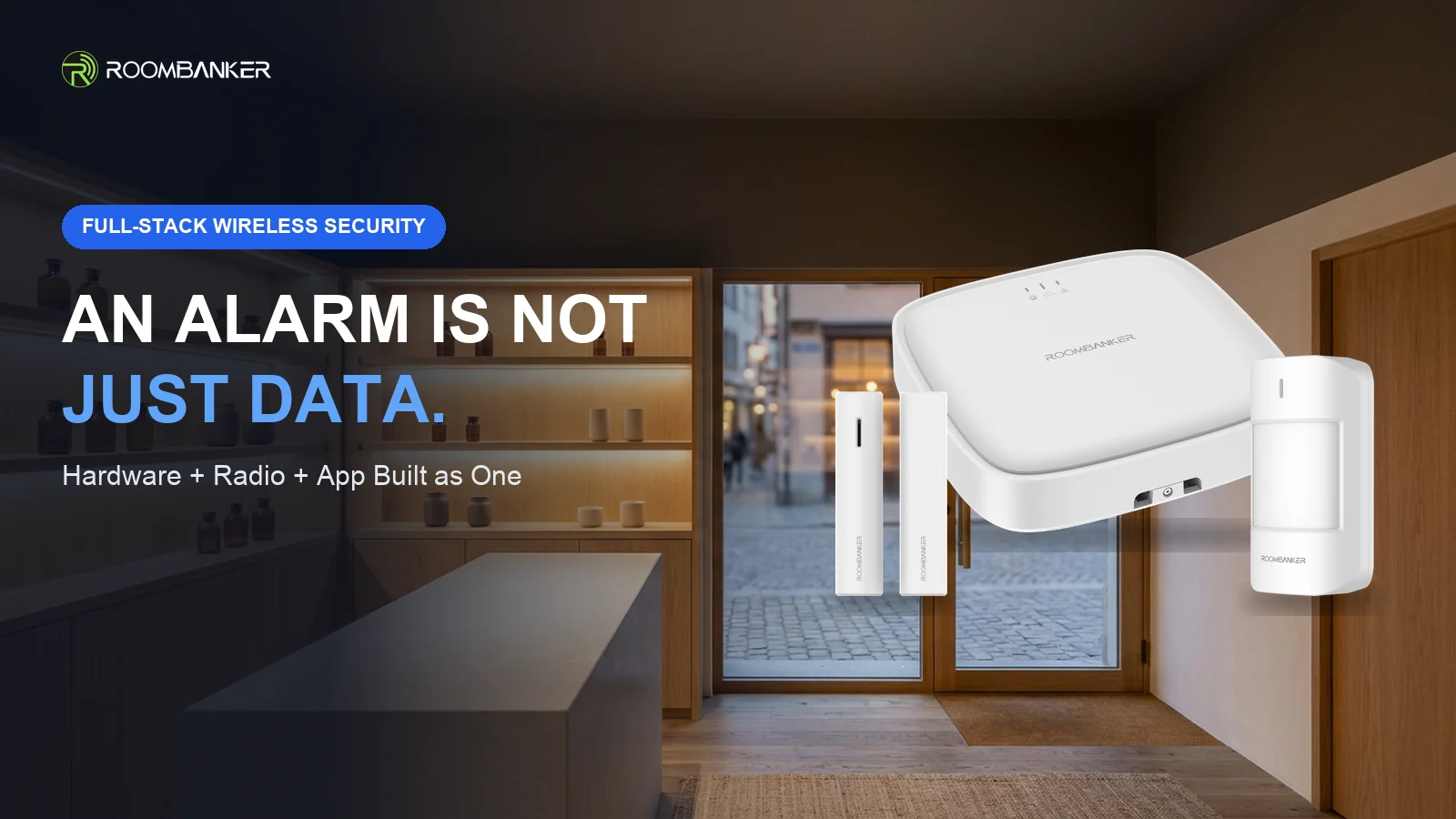
What Really Happens After an Alert Fires?
Walk into any modern commercial building and you will find sensors everywhere. HVAC controllers log temperature drift, smart plugs track power loads, and IoT gateways push hundreds of status messages a day.
Then a real problem happens at 2 a.m.
An alert pops up on a building automation dashboard. A phone buzzes once on someone’s nightstand. Nobody wakes up, nobody calls the keyholder, and by morning the trail has gone cold.
In professional security, that outcome is unacceptable. A wireless intrusion alarm is never built just to display a message—it is built to force a clear human response, and that difference changes how every piece of hardware and software must be made.
In Security, an Alarm Is Not Data. It Is an Instruction.
Building automation platforms were born to visualise equipment. Security control rooms were born to handle risk under pressure.
When an armed pharmacy or warehouse triggers an alarm in the middle of the night, the operator at the alarm receiving centre (ARC) does not want raw telemetry. They need four things immediately:
- Clear ownership: Who is on duty right now to take this call?
- Exact context: Did someone force the back door, or did someone pry the sensor off the wall?
- A defined playbook: Who gets called first, and when do guards or police get dispatched?
- An unbroken audit trail: Every second—from trigger to acknowledgment to reset—stays on record.
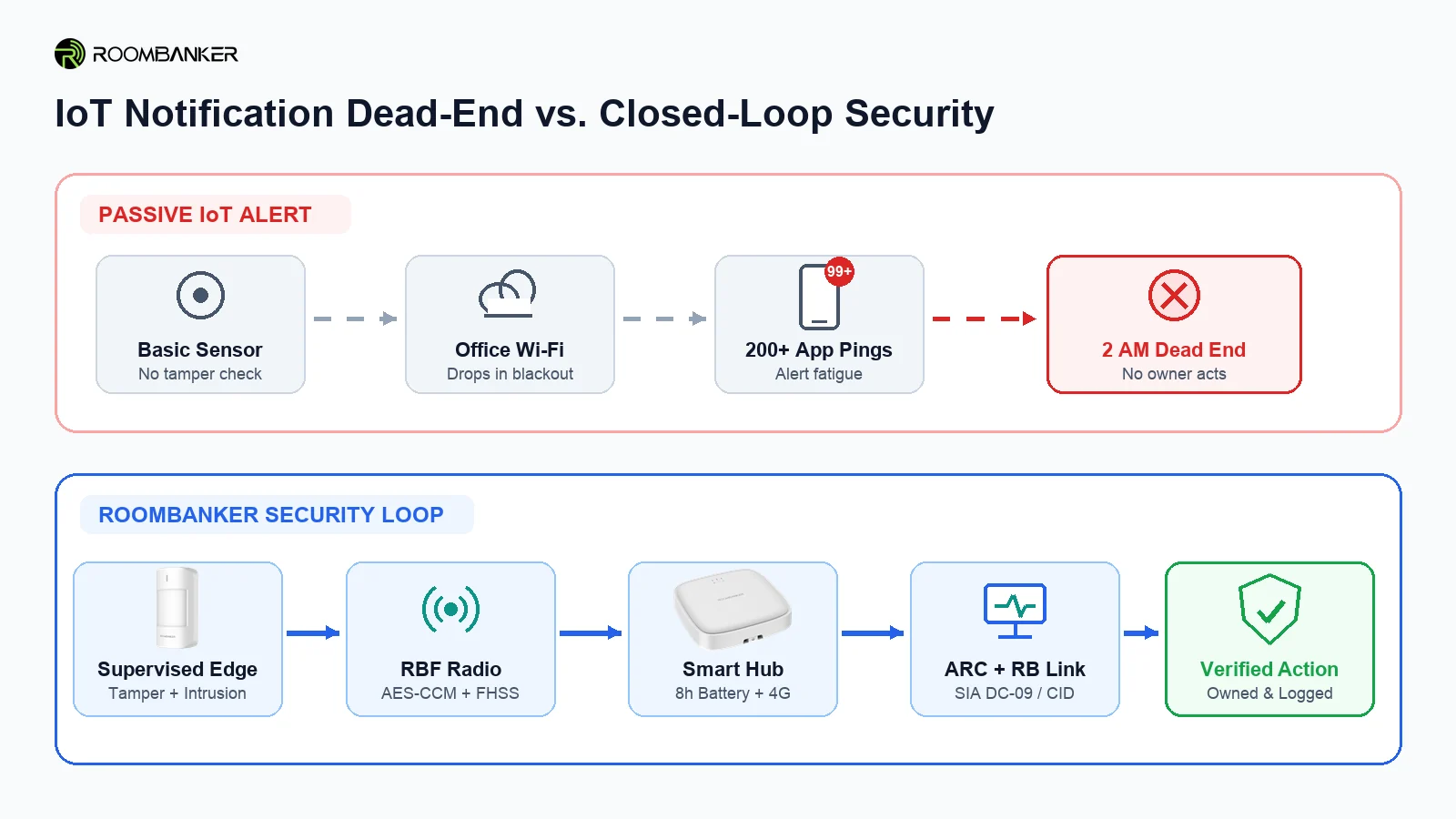
If you run a security distributor or installation business, you feel this difference on your balance sheet. Every ambiguous IoT-style notification becomes a frustrated support call; a clean, unambiguous alarm protects both your client’s premises and your service team’s schedule.
Five Questions Commercial Buyers and Distributors Are Asking
As smart-building tech and commercial security overlap, buyers are running into painful surprises—and asking sharper questions:
1. “Why did we miss the real break-in when the app sends 200 alerts a day?”
Because noise trains people to ignore their phones. When routine door chimes, temperature shifts, and real break-ins land in the same feed, human attention breaks down. Urgent alarms need their own fast lane straight to people paid to act.
2. “Why did the whole system go silent when the shop lost internet?”
Because most IoT sensors assume the office Wi-Fi and mains power will always be there. If a burglar cuts the broadband line—or a storm knocks out the router—a silent app looks identical to a safe building.
3. “Why can’t a prettier app fix false alarms on site?”
Because software only knows what the sensor and radio tell it. If a cheap contact loses its signal the moment a steel roller shutter closes at night, no cloud dashboard on earth can rescue that missing packet.
4. “Why did a routine app update break our monitoring station codes?”
Because many brands on the market do not actually build their own full stack. They buy white-label hardware from one factory, rent a generic IoT app from a second vendor, and bolt on an ARC translator at the end. When one vendor pushes an update on Friday, your installer spends Monday figuring out why tamper alerts stopped reaching the ARC.
5. “When three vendors point fingers at each other, who fixes the fault?”
You already know the answer: the local installer and the security distributor end up paying for it. Each supplier shows a green light on their own piece while the alarm disappears in the gap between them.
Why Hardware-Only and Software-Only Models Both Hit a Wall
Great security cannot be assembled from strangers’ parts.
A software-only platform can draw a clean dashboard, yet it is blind to the physical world. For instance, it cannot stop radio interference on a crowded sub-GHz band, sense a pried casing, or keep a hub alive during a six-hour blackout.
A hardware-only factory can mold a solid detector, yet lose control the moment the signal leaves the circuit board. Relying on a rented third-party app means weak installer diagnostics, clumsy workflows, and event codes that drift out of sync over time.
| Evaluation Dimension | Piecemeal IoT / White-Label Kit | Unified Full-Stack Security (Roombanker) |
|---|---|---|
| Edge & Radio Control | Generic Wi-Fi/RF modules; blind “Online/Offline” app status | In-house two-way RBF radio + live signal test in RB Link |
| Power & Network Outages | Fails silently when office broadband or mains power drops | Built-in 8h battery + R2 PRO 4G SIM failover + fault reporting |
| Firmware & ARC Releases | Split vendors; app or firmware updates can scramble event codes | Sensor firmware, Hub OS, RB Link & SIA/CID maps tested together |
| Field Fault Ownership | Multi-vendor finger-pointing; installer absorbs callback cost | One manufacturer traces trigger, Hub log & outbound ARC packet |
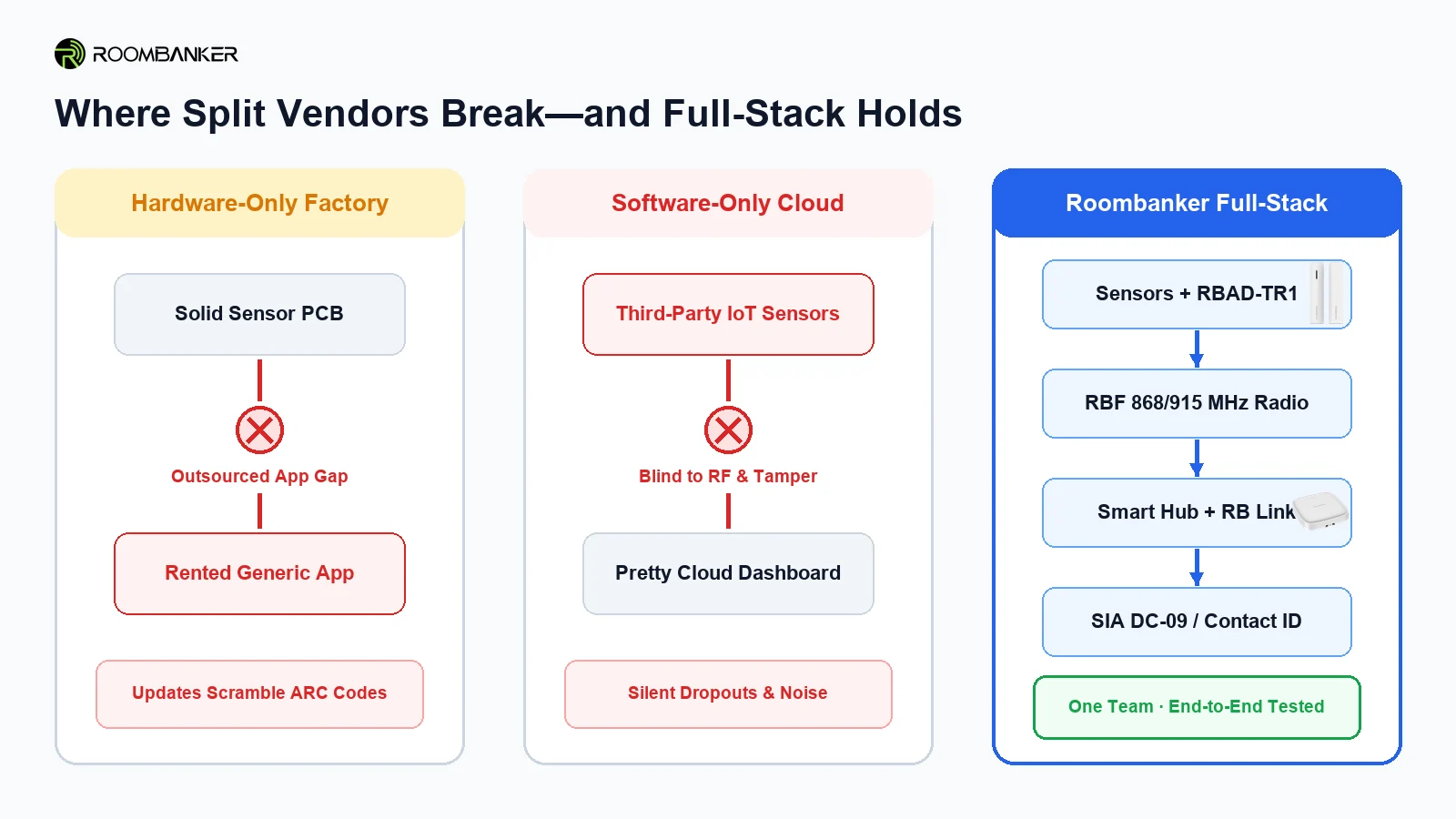
Closing the gap takes one alarm manufacturer willing to do the hard work of building both halves under the same roof.
How We Engineer Hardware and Software Together at Roombanker
At Roombanker, we did not wrap a generic smart-home app around off-the-shelf sensors. Our hardware engineers, RF protocol team, and app developers build around the same event chain—answering each of those five field headaches directly:
1. Urgent alarms never drown in everyday chatter
Our detectors separate intrusion, tamper, panic, smoke, and water leaks right at the source. In our RB Link app, routine activity—arming, disarming, status across up to 64 rooms, or lighting scenes—stays neatly organised in the log, while emergencies trigger high-priority alerts and direct ARC reporting. For example, when a cashier presses a panic button, the operator sees an unmistakable panic alarm—not a generic status ping.
2. Power cuts and dead routers do not blind the site
Our Smart Hub R2 and R2 PRO are built for real outages. R2 handles up to 64 peripherals over Ethernet and 2.4 GHz Wi-Fi; R2 PRO scales to 128 peripherals and adds an independent 4G SIM path so alarms still get out when shop broadband dies. Both carry a 2,500 mAh backup battery for up to eight hours (and can run off an external UPS backing up both the Hub and router on sites needing longer runtime), while two-way supervision flags power loss or missing sensors instead of failing silently.
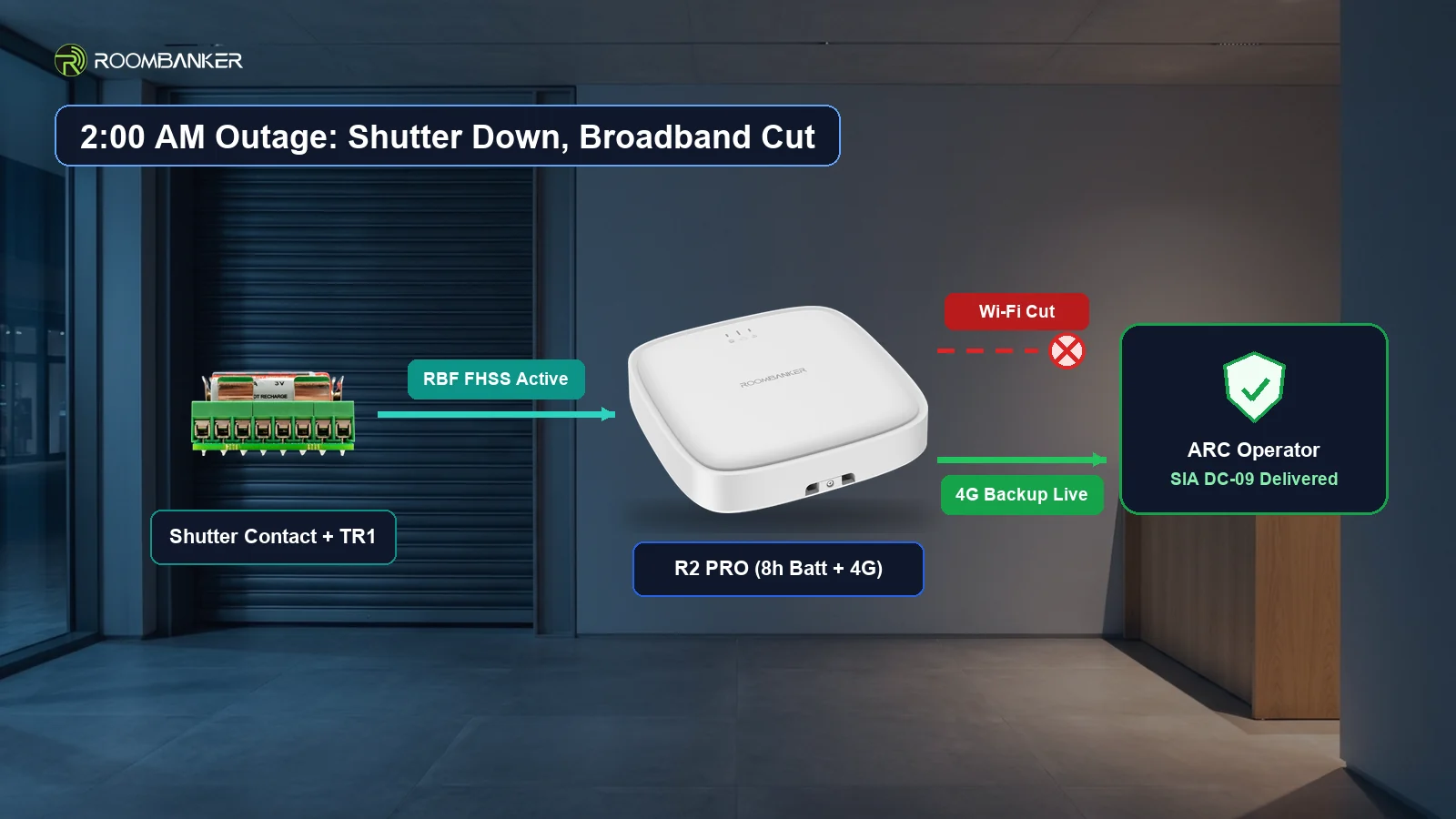
3. Clean signals start at the window, the shutter, and the radio
Before software ever touches an event, the physical edge has to get it right:
- Purpose-built perimeter hardware: Pet-immune PIR motion detectors cut everyday nuisance triggers; our Door Window Sensor G2 lets installers set 5°–25° tilt thresholds and control the opening switch independently on tilt windows and skylights; and our RBAD-TR1 keeps
ALARMandTAMPon separate inputs when you upgrade legacy wired sensors without rewiring. - In-house RBF radio + live app diagnostics: We build our two-way RBF wireless technology in regional 868 MHz and 915 MHz hardware versions, using AES-CCM encryption and frequency hopping (FHSS) to dodge single-channel interference. Because RB Link speaks natively to RBF, your installer can close the shop’s steel shutter, read live signal strength on their phone, and reposition a weak unit—or add an RBF repeater—before handing over the keys.
4. One release train from sensor firmware to ARC receiver
Because we write our own detector firmware, Hub OS, RBF stack, and RB Link—and maintain the encrypted IP (SIA DC-09) and ADM-CID (Contact ID) event tables for our ARC integration—we regression-test the whole chain before shipping an update. A firmware tweak on a door sensor will not quietly scramble the tamper code your monitoring centre expects to see.
5. One engineering team on the hook—plus smarter automation
When a distributor or ARC needs to trace a tricky site issue, there is nobody to pass the buck to. Our team can follow one event from the detector trigger, through the Hub log, right down to the outbound ARC packet.
And once you have a security foundation that actually tells the truth about a building’s state, building automation gets better too. For instance, arming a retail store at closing time can switch off display lights automatically, or a water leak sensor in a basement plant room can trip a relay while alerting the on-call manager. Automation works best when it rides on top of security-grade discipline—not the other way around.
The Bottom Line
Anyone can make a sensor send a phone notification when everything goes right. Suppose a storm cuts shop Wi-Fi at 2 a.m. while the steel shutter is down: a professional wireless alarm earns its keep when someone on duty still gets an alert they can trust.
Ready to benchmark a full-stack security alarm manufacturer? Share your regional band (868 MHz or 915 MHz), typical peripheral count, wired-retrofit mix, and target SIA DC-09 or ADM-CID receiver to request a bench evaluation kit or regional terms through our European distributor programme or our global partner portal.