
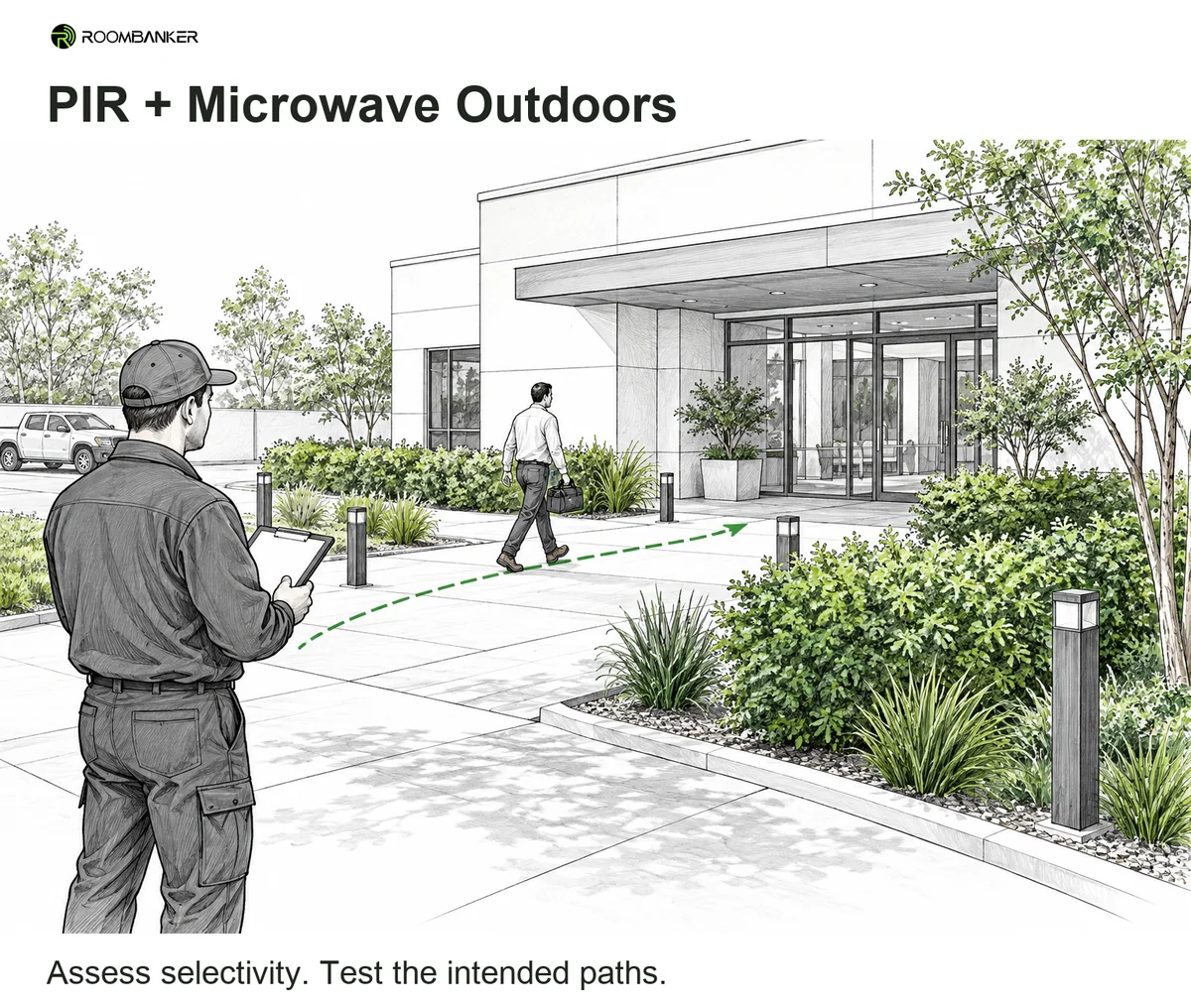
PIR and microwave sensing provide different information about movement. Combining those inputs can help a detector distinguish intended movement from disturbances that affect only one sensing method.
When you compare outdoor detectors, count unwanted alarms and missed crossings separately. You need fewer nuisance calls without losing detection along the paths you protect.
How should dual-technology sensor accuracy be measured?
Measure intended detection and unwanted activations separately. Detection rate is successful detections divided by planned crossing tests under stated conditions; record missed crossings as well. Count unwanted alarms over a defined observation period with equivalent coverage and settings. A percentage without those definitions cannot show whether a dual-tech detector improves the installation.
What does temperature-compensated PIR–microwave detection mean?
Temperature compensation adjusts the PIR response as operating conditions change. RBSS-PS2 supports temperature compensation alongside PIR and microwave sensing. When background temperature approaches a person’s surface temperature, reduced infrared contrast makes PIR detection harder. Compensation helps address that change, while placement and walk testing remain necessary for both sensing paths.
Does PIR–microwave dual technology prevent missed detections?
Requiring both sensing inputs can reject a disturbance that affects only one. It can also miss intended movement when either input receives too weak a signal. Anti-miss evaluation therefore needs tests across the full intended route, including its edges, rather than assuming the microwave channel overrides a weak PIR response.
How do you investigate a microwave false trigger?
Compare unwanted alarms with nearby movement such as branches, birds or vehicles. Reposition the detector to exclude that activity before reducing sensitivity, then repeat crossing tests. In a dual-tech detector, examine the PIR conditions too: an alarm can reflect disturbances affecting both inputs rather than a microwave fault alone.
What should you compare in PIR and microwave integration designs?
For designs described as 2024–2025 sensor-fusion trends, compare the actual decision rule, temperature compensation and field-test method. Ask for field-test results for the exact model and mounting position. For outdoor alarm use, the useful comparison is fewer nuisance activations with intended crossing paths still detected under equivalent conditions.
Why outdoor conditions challenge motion detection
Outdoor movement and changing thermal conditions can produce unwanted responses within a sensor’s detection area. PIR and microwave respond to different inputs:
- PIR: changes in infrared radiation across detection zones.
- Microwave: movement detected from the Doppler frequency shift between transmitted microwave energy and its reflected return.
If you fit a detector beside a loading-bay entrance, mark the pedestrian crossing path and nearby vehicle or vegetation movement. Aim to cover that path while keeping unrelated activity outside the detection area.
How combined PIR and microwave sensing works
A dual-tech detector uses both sensing inputs in the event decision. One design approach requires confirmation from both inputs before reporting an alarm. A disturbance affecting only one input may then be filtered out.
Both sensors must receive a strong enough signal from the movement you want to detect. Poor placement can weaken either signal; a disturbance affecting both inputs may still trigger an alarm. If you find a missed crossing at the edge of an entrance path, revisit the position and test that edge again.
Use the model’s instructions to check how it combines the inputs, timing and operating modes; the approach described here is a general dual-tech design principle.
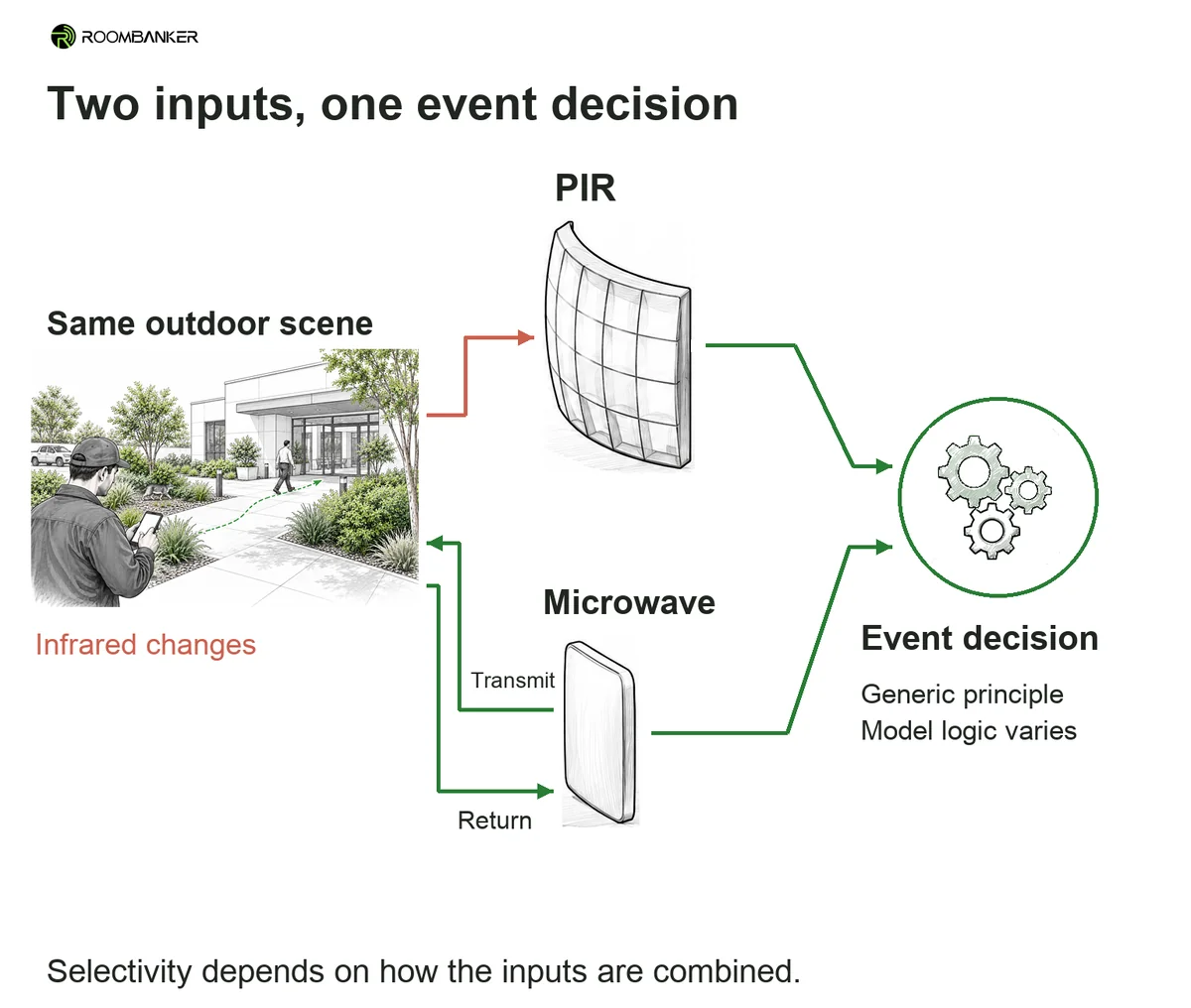
Check what caused a dual-tech alarm before deciding how to respond. Both sensing inputs can react to a disturbance, so you still need to identify the cause and follow the response procedure.
PIR plus microwave also differs from two PIR elements. The motion-detector types guide explains those categories when comparing products.
What a false-alarm reduction claim must show
Fewer alarms only help if intended movement is still detected. A useful comparison uses equivalent coverage and test conditions, and records both unwanted activations and missed detections.
Look for four details in the test results:
- The baseline detector and its settings.
- The detection area and intended crossing paths.
- What counts as an unwanted activation or missed detection.
- The observation period and site conditions.
If you lower sensitivity on a detector facing a garden path, repeat the same crossing tests and keep a separate count of unwanted alarms. Fewer alarms are no improvement if the new setting misses someone on the path. Keep the coverage and test conditions equivalent when comparing settings. For example, use the same entrance route before and after moving the detector away from vegetation. Note which crossings it detects, which it misses and what nearby activity accompanies unwanted alarms. You can then see whether the new position improves detection as well as reducing nuisance calls.
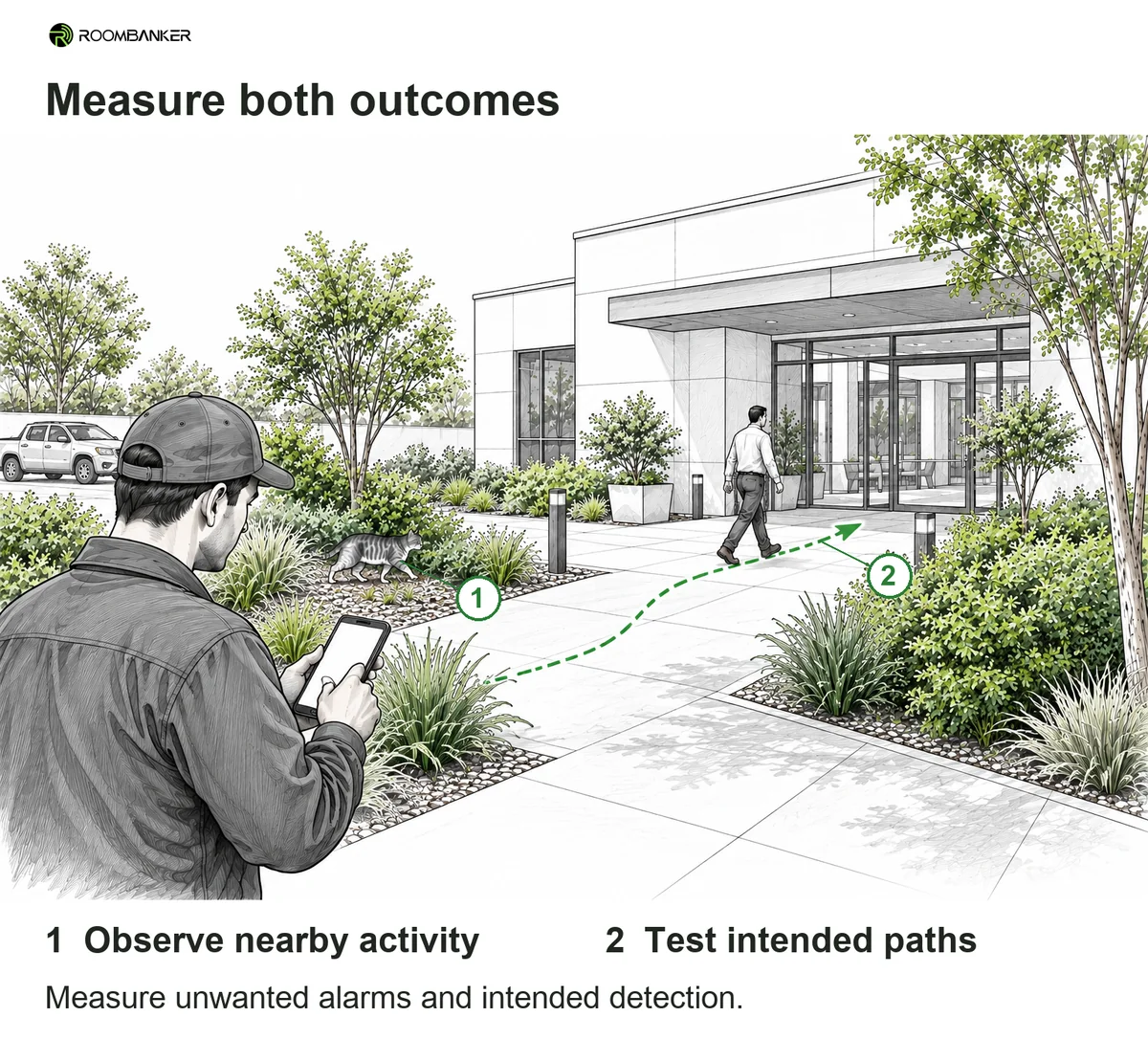
Notes on vegetation, animal routes and changing conditions help explain the result and guide position or setting changes. Observe the site over a defined period that includes those conditions before calculating a reduction percentage; one quiet day is too short.
Disturbances to include in the evaluation
Start with the detector’s position when investigating unwanted alarms. If you place it beside an exhaust outlet or moving vegetation, try a position that keeps those disturbances outside its sensing area before adjusting sensitivity. Dual-tech detectors can still give false alarms.
Test the routes pets can reach, including raised surfaces that bring an animal into a different part of the detection pattern. Use the intended installation and pet settings, and test human crossing paths too.
For an existing problem, the false-alarm troubleshooting guide helps investigate the cause before replacing a detector.
Assessing RBSS-PS2 for a project
RBSS-PS2 combines PIR and microwave sensing. Review the RBSS-PS2 product against the proposed approach zone, then use the outdoor detector QSG for model-specific placement and testing.
RBSS-PS2’s published operating range is −10°C to +60°C, with temperature compensation listed in its specification. If you plan to mount it beside a sunlit entrance, follow the quick-start guide’s restrictions on direct sunlight and large temperature changes when choosing the position. Then test under the conditions you expect there.
Match the detector’s regional variant to your Hub and project market. Ask your supplier which certificate covers the RBSS-PS2 variant sold in your market. Give your supplier the model and regional variant you plan to use in the project.
The environmental comparison helps if the indoor-versus-outdoor choice is still unresolved. For a project enquiry, share the layout, target paths, nearby movement, exposure, Hub and market.