
Many people describe a PIR sensor simply as “a device that detects motion.” In everyday smart-home use, that may be enough. A motion sensor turns on a light, starts an automation, or sends a notification when movement is detected.
In the European professional alarm market, however, installers and buyers often look at PIR sensors through a different lens. Terms such as EN50131 and Grade 2 are used to judge whether a detector is suitable for an intrusion alarm system, not just whether it can sense movement.
EN50131 is not just a certificate label. For PIR motion detectors, it relates to security grade, detection reliability, tamper protection, environmental suitability, system-level alarm handling, and false-alarm control. A certified Grade 2 PIR sensor is therefore evaluated as part of a professional alarm system, where reliability and compliance boundaries matter.
What Is EN50131 for PIR Motion Detectors?
EN50131 is a European standard family for intrusion and hold-up alarm systems. It covers different parts of an alarm system, including control panels, detectors, signaling devices, power supplies, and system requirements.
For PIR motion detectors, EN50131 helps define expectations beyond basic motion sensing. A PIR detector in an intrusion alarm system is expected to detect movement within a protected area, communicate alarm or tamper conditions correctly, and work within defined environmental and security requirements.
EN50131-2-2 is the part commonly associated with passive infrared detectors. It addresses PIR detector requirements in a professional alarm context. For buyers and installers, the exact standard number on a certificate helps confirm what type of device was assessed and under which version of the standard.
This does not mean every installer needs to read the full standard before selecting a sensor. But it does mean that an EN50131-certified PIR should be evaluated differently from an ordinary motion sensor used only for smart-home automation.
What Does Grade 2 Mean for a PIR Sensor?
EN50131 uses security grades to describe different risk levels. In simple terms:
| Security grade | General meaning | Typical risk context |
|---|---|---|
| Grade 1 | Low risk | Basic protection where intruders are expected to have little knowledge |
| Grade 2 | Low-to-medium risk | Intruders may have limited knowledge of alarm systems and common tools |
| Grade 3 | Medium-to-high risk | Intruders may have more knowledge and tools |
| Grade 4 | High risk | High-security applications with more advanced attack expectations |
For PIR motion detectors, Grade 2 is commonly associated with homes, small offices, shops, small businesses, and normal indoor protected areas where Grade 2 alarm detection is required. It is often used where a professional alarm system needs a higher level of assurance than a basic consumer motion sensor.
Grade 2 does not mean suitable for every European project. Some sites may require different grades, different environmental classes, or specific insurer and local compliance requirements. Installers should always check the project specification before choosing a detector.
EN50131 PIR Sensor vs Ordinary Smart Home Motion Sensor
Smart-home motion sensors can be useful for automation. They may trigger lights, scenes, or app routines. But professional alarm systems have different requirements.
| Comparison point | EN50131 PIR sensor | Ordinary smart-home motion sensor |
|---|---|---|
| Main purpose | Intrusion alarm detection | Automation, convenience, basic alerts |
| Certification | May be tested against alarm standards such as EN50131 | Often not certified for professional intrusion systems |
| Tamper handling | Expected in professional alarm design | May be limited or absent |
| Alarm integration | Works as part of an alarm system workflow | Often works inside a smart-home ecosystem |
| Installation testing | Usually requires installer verification | Often simple user setup |
| False alarm control | Designed to support stable alarm detection under defined conditions | Varies by device and use case |
| Project compliance | Can support professional system requirements when correctly specified | May not meet alarm project requirements |
This does not make smart-home sensors “bad.” It means they are designed for a different use case. A sensor that works well for lighting automation may not meet the requirements of a professional intrusion alarm system.
Detection Reliability: More Than Detecting Movement
Detection reliability is not only about whether a PIR sensor can notice movement. In a professional alarm detector, the quality of detection depends on the full sensing design and installation conditions.
Important factors include:
- Detection range
- Horizontal detection angle
- Recommended installation height
- Fresnel lens and detection zone design
- PIR sensor stability
- Sensitivity setting
- Light filtering
- Temperature and environment conditions
- Walk testing after installation
A PIR detector reacts to changes in infrared energy across detection zones. If the lens pattern, installation height, or detection direction is poorly matched to the room, the detector may miss important movement or react to unwanted sources. If the detector faces sunlight, heaters, moving curtains, or strong airflow, false alarm risk may increase.
This is why detection specifications should be read together. Range alone is not enough. A 12 m detection distance, for example, is useful only when the detector is installed at the recommended height and aimed toward the correct protected area.
Tamper Protection and System-Level Alarm Signals
Tamper protection is one reason professional alarm detectors differ from simple motion sensors. In an intrusion alarm system, the detector should not only report motion. It should also help the system understand if the device has been opened, removed, or affected in a way that may compromise protection.
Tamper-related functions may include:
- Device opening detection
- Rear tamper protection
- Tamper alarm reporting to the hub or control panel
- Low battery or fault awareness where supported
- System-level event handling
For installers, tamper handling matters because it affects how the alarm system responds before, during, and after an intrusion event. A detector that reports motion but does not support suitable alarm and tamper handling may not fit a professional alarm project.
This section should not be confused with higher-grade features such as anti-masking or photo verification. Those are separate capabilities and should only be claimed when they are clearly specified for the product.
Environmental Class: Why Installation Conditions Matter
EN50131 projects also require attention to environmental class. Environmental class describes the type of conditions where a device is intended to operate.
In general alarm system discussions, environmental classes may relate to:
- Stable indoor environments
- Indoor environments with more temperature variation
- Sheltered outdoor or semi-outdoor environments
- Outdoor environments with wider weather exposure
For PIR motion detectors, this matters because temperature, airflow, sunlight, humidity, dust, and installation location can affect detection performance and false alarm risk. A detector intended for stable indoor use should not automatically be selected for outdoor or semi-outdoor areas.
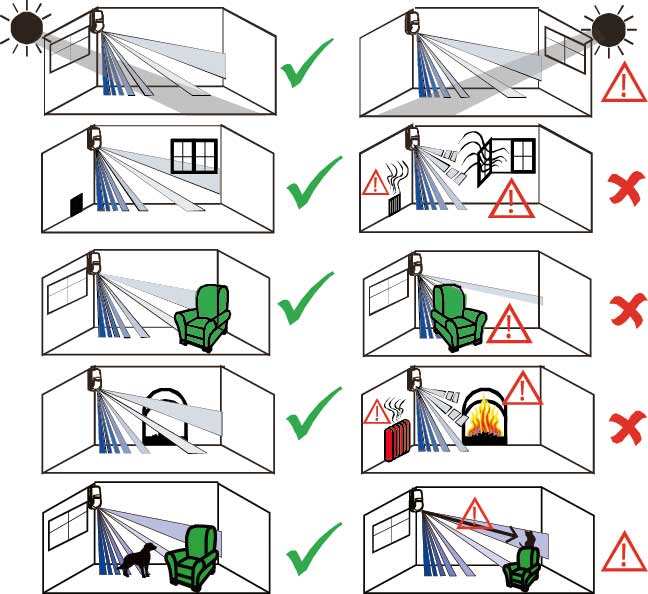
Installers should check the official certificate, datasheet, and installation manual for the environmental classification or stated installation environment. If the environmental class is not clearly shown in public materials, buyers should confirm it with the manufacturer or supplier before using the device in an EN50131 project.
False Alarm Control Under Professional PIR Requirements
False alarm control is a major part of professional PIR selection. A certified alarm sensor should support stable detection, but no PIR sensor can eliminate false alarms in every environment.
Common false alarm factors include:
- Pets moving through the detection area
- Direct sunlight or reflections
- Heaters, fireplaces, or radiators
- HVAC airflow
- Insects near the lens
- Moving curtains or plants
- Incorrect mounting height or angle
- Sensitivity set too high for the room
- Low battery or maintenance issues
Professional PIR design may help reduce false alarms through lens design, light filtering, sensitivity control, temperature compensation, sealed structure, tamper protection, and proper system testing. But installation remains critical. A good detector can still perform poorly if it is aimed at a window, mounted too low, or installed near strong heat movement.
A realistic claim is that a detector helps reduce false alarms or supports false-alarm resistance under suitable installation conditions. It should not be described as guaranteeing no false alarms.
How to Check an EN50131 Grade 2 PIR Sensor Before Selection
Before choosing a Grade 2 PIR detector, installers and buyers should check more than the product name.
| Check item | What to confirm |
|---|---|
| Certificate standard numbers | Does the certificate clearly list the relevant EN50131 standards and versions? |
| Security Grade | Is the device certified as Grade 2, and does that match the project requirement? |
| Environmental Class | Is the installation environment suitable for the certified use conditions? |
| Wired or wireless requirement | Does the project require wired, wireless, or hybrid system design? |
| Hub or system compatibility | Can the detector work with the selected control panel or alarm hub? |
| Tamper protection | Does it support tamper reporting required by the project? |
| Detection range and angle | Do the coverage specifications match the protected area? |
| Installation height | Can the detector be installed at the recommended height? |
| Battery and low battery | For wireless devices, what battery type and low battery notification are supported? |
| App or testing support | Can installers test signal, detection, and configuration where supported? |
| Installation manual | Are mounting, sensitivity, pet immunity, and testing instructions clear? |
| Project or insurer requirements | Does the final system meet local project, insurer, or regulatory requirements? |
A Grade 2 label is important, but it should be checked together with the full system design.
Roombanker Indoor PIR as a Grade 2 Example
Roombanker Indoor PIR Sensor is certified to EN 50131-2-2:2021 and EN 50131-1:2006+A1:2009+A2:2017+A3:2020, with Security Grade 2.

This makes it an EN50131 Grade 2 certified indoor PIR sensor suitable for professional alarm systems where Grade 2 indoor PIR detection is required, subject to project conditions and system design.
Key specifications include:
| Item | Roombanker Indoor PIR Sensor |
|---|---|
| Detection distance | Up to 12 m |
| Horizontal detection angle | 110° |
| Recommended installation height | 1.8 m to 2.4 m |
| Pet immunity | Up to 10 kg, subject to installation height and environment |
| White light filter | 2000 lux |
| Tamper protection | Rear tamper protection |
| App support | RB Link App remote setting and testing |
| Signal function | Signal strength detection |
| Battery alert | Low battery notification |
| Wireless communication | RBF two-way communication |
| RF distance | Up to 3,100 m open space with Hub |
| Security communication | AES-CCM encryption, FHSS, TDMA |
| Battery | CR123A x 1 |
| Standby mode | Up to 5 years |
These parameters should be considered together with the installation manual, mounting position, hub compatibility, and project requirements. Roombanker Indoor PIR is one Grade 2 example, not the only possible Grade 2 PIR detector for every project.
FAQ
What is EN50131?
EN50131 is a European standard family for intrusion and hold-up alarm systems. It helps define requirements for alarm system components, including detectors, control equipment, signaling devices, and system performance.
What does Grade 2 mean for a PIR sensor?
Grade 2 generally refers to low-to-medium risk alarm applications where an intruder may have limited knowledge of alarm systems and common tools. For PIR sensors, it indicates suitability for Grade 2 intrusion alarm projects when installed and used correctly.
Is Grade 2 enough for home alarm systems?
Grade 2 is commonly used for homes, small offices, shops, and small businesses, but it is not automatically enough for every project. Installers should check local requirements, insurer expectations, and the full system design.
What is the difference between Grade 2 and Grade 3 PIR detectors?
Grade 3 is intended for higher-risk applications than Grade 2 and may require additional capabilities depending on the standard and product type. A Grade 2 PIR should not be described as Grade 3 unless it is clearly certified as such.
Does EN50131 certification eliminate false alarms?
No. EN50131 certification does not eliminate false alarms. It supports professional alarm requirements, but false alarm risk still depends on environment, installation, sensitivity settings, maintenance, and user operation.
Is an EN50131 PIR sensor better than a smart-home motion sensor?
For professional intrusion alarm systems, an EN50131 PIR sensor is usually more appropriate because it is designed and tested for alarm-system requirements. Smart-home motion sensors may still be useful for automation, but they may not meet professional alarm project needs.
What should installers check before choosing a Grade 2 PIR sensor?
Installers should check the certificate standard numbers, Security Grade, Environmental Class, detection range, installation height, tamper protection, battery and low battery functions, hub compatibility, testing tools, installation manual, and project requirements.
Is Roombanker Indoor PIR EN50131 Grade 2 certified?
Yes. Roombanker Indoor PIR Sensor is certified to EN 50131-2-2:2021 and EN 50131-1:2006+A1:2009+A2:2017+A3:2020, with Security Grade 2.